
Identifying Additional Rare Missense Associations with Genomic AI
GPN-Star expands rare-variant association signals beyond NeuroRisk, with modest internal prediction gains for selected traits

Reticular Team
Research Team

Introduction
Our goal at Reticular is to build genetic prediction models that integrate information across the genome. Here, we focus on rare coding variants that are not directly represented in common-variant polygenic scores. Although some rare variants have substantial biological effects, their low frequency makes it difficult to estimate their individual contributions from population data. A practical alternative is to aggregate variants into biologically informed burden scores, either by region or by gene.
A principled way to weight the impact of rare variation within a gene is to use the evolutionary constraint of the affected gene. Some genes contain fewer loss-of-function variants than expected from their mutation rates, indicating stronger selection against disruption of one copy. This methodology was recently demonstrated by the NeuroRisk framework, which uses estimates of selection against heterozygous loss-of-function variants, sHet, to weight affected genes and construct participant-level genetic loads. This study found associations between rare-variant genetic load and several cognitive and neuropsychiatric outcomes.
Variant inclusion plays a critical role in the utility of rare variant burdens. Stringent thresholds using conventional pathogenicity models prioritize variants with strong predicted functional evidence, but can leave out other phenotype-associated variants. Recent advances in genomic machine learning offer another way to evaluate genetic variation by learning patterns of evolutionary constraint from large-scale genomic sequence data. We used GPN-Star, a phylogeny-aware genomic language model trained on multispecies sequence alignments, to identify additional rare missense variation potentially relevant to disease. We asked whether this selection rule based on a genomic language model could recover additional phenotype-associated burden while retaining the original NeuroRisk components.
Using whole-genome sequencing data from the All of Us Research Program, we found that the GPN-Star-selected rare missense burden captures additional, complementary association with several phenotypes. These findings demonstrate that the original damaging-missense gate does not exhaust the available association signal, while also highlighting important limitations in attributing the improvement to individual variant predictions.
Using evolutionary models to expand rare variant identification
NeuroRisk aggregates rare damaging variants into a participant-level genetic load, weighting affected genes by their estimated strength of negative selection. Genes under stronger selective constraints receive greater weight, reflecting the expectation that disruptive variation in these genes may have larger phenotypic effects.
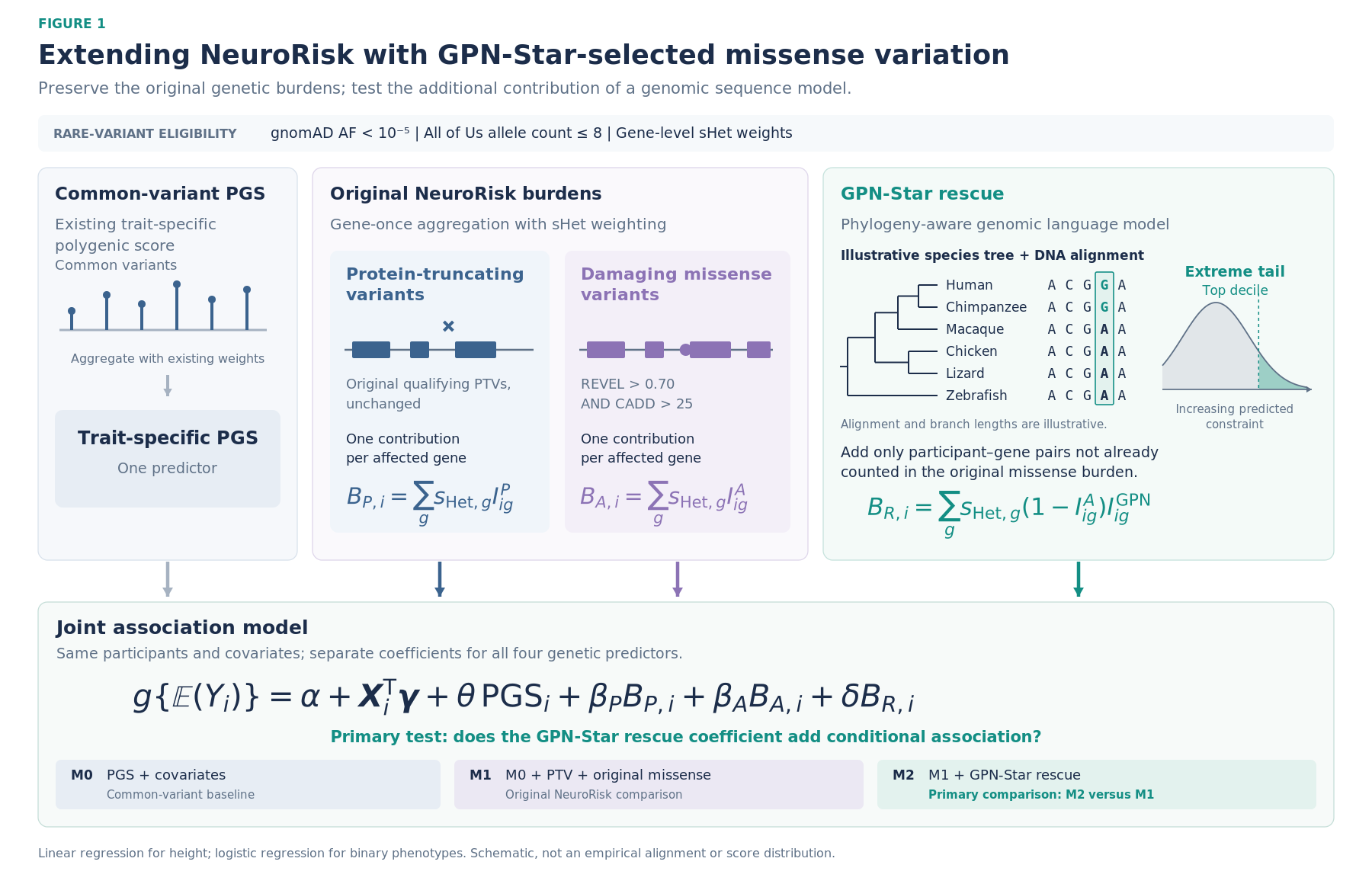
For damaging missense variants, our reproduction of the original NeuroRisk framework used the intersection of two established annotation thresholds: REVEL v1.3 > 0.70 and CADD v1.7 > 25. Each qualifying gene contributes once to the participant's burden, weighted by its gene-level selection coefficient. This approach is statistically efficient, but necessarily excludes rare missense variants that do not satisfy both thresholds. We therefore investigated whether GPN-Star could provide an additional source of evidence for identifying potentially functional variants.
GPN-Star incorporates whole-genome sequence alignments and phylogenetic relationships across species to estimate evolutionary constraints. Its predictions reflect patterns of sequence evolution rather than relying directly on phenotype associations in the All of Us cohort. By comparing how evolutionarily surprising a candidate substitution is, calibrated by the expected mutation rate at a sequence, GPN-Star provides a sequence-based constraint score for prioritizing candidate variants. We used the vertebrate GPN-Star model and selected variants within the top decile of predicted constraint. For each participant, we retained the original NeuroRisk missense burden and added a separate GPN-Star rescue burden. A gene enters a participant’s rescue burden only if the participant carries a qualifying GPN-Star-selected missense variant in that gene and that gene is absent from that participant’s original missense burden. Each gene contributes only once within a component, using the same sHet weights.
This construction is important. It preserves the original NeuroRisk burden and asks whether GPN-Star identifies additional genetic information, rather than replacing one annotation system with another. We evaluated this framework across nine phenotypes: schizophrenia, bipolar disorder, depression, autism, intellectual disability, ADHD, anxiety, suicide attempt and height, using logistic regression for binary traits and linear regression for height. The underlying annotation and carrier-index analysis covered more than 535,000 sequenced All of Us participants, while phenotype association analyses used the eligible European (EUR), Admixed American (AMR), and African (AFR) ancestry subsets. Variants were restricted to an ultra-rare frequency regime, including an external allele-frequency threshold below 10⁻⁵ and an All of Us carrier count of at most eight.
Common-variant polygenic scores
We constructed common-variant polygenic scores using publicly available external GWAS summary statistics. All analyses in this report use a panel of approximately 1 million variants. The companion patient guide presents results using updated common-variant scores based on approximately 7.7 million variants. Within each analysis, the models being compared use the same common-variant baseline.
Genomic language models recover additional rare-variant associations beyond NeuroRisk
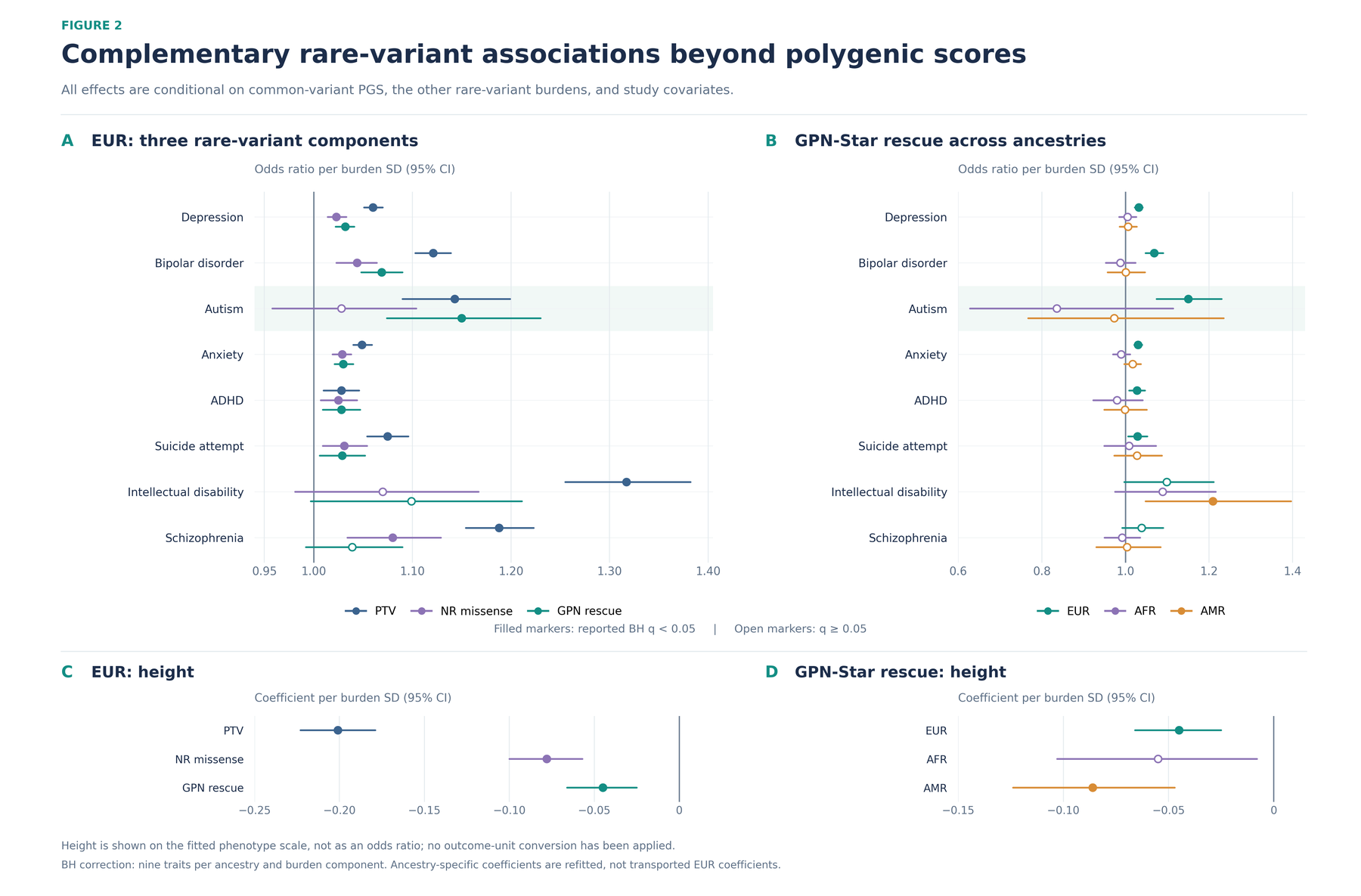
We first investigated whether the GPN-Star rescue burden was associated with each of the nine traits, after adjustment for common-variant polygenic scores, NeuroRisk protein-truncating and damaging-missense burdens, and demographic, ancestry and sequencing covariates. In European-ancestry participants, the GPN-Star-selected rescue burden showed significant conditional associations with seven of nine phenotypes after Benjamini-Hochberg correction for multiple testing. These were bipolar disorder, depression, autism, ADHD, anxiety, suicide attempt, and height. Intellectual disability and schizophrenia did not meet the corrected significance threshold. The additional association was particularly notable for autism, where the GPN-Star rescue burden was associated with higher odds of an autism diagnosis (OR per SD = 1.15, 95% CI 1.07–1.23). For autism, the original NeuroRisk damaging-missense component was not significantly associated with diagnosis in the same joint model. GPN-Star also retained associations with bipolar disorder (OR per SD = 1.07) and depression (OR per SD = 1.03) after adjustment for both original rare-variant components and common-variant polygenic risk. These odds ratios describe conditional associations per burden standard deviation. We assess additional model fit and prediction separately below.
Evidence differed across ancestry groups
The additional identified associations were not uniform across ancestry groups. Rare-burden coefficients were estimated separately within each ancestry group; the analysis did not evaluate transport of frozen EUR prediction coefficients. The additional GPN-Star rescue burden was associated with height and intellectual disability in AMR participants, while no AFR association survived multiple-testing correction. Formal heterogeneity analyses identified EUR–AFR differences for bipolar disorder and anxiety. These are differences in the observed burden associations; they do not by themselves establish ancestry-specific biological effects. These observations highlight the importance of evaluating rare-variant representations in diverse populations. The variation across ancestries may reflect differences in statistical power, phenotype ascertainment, and variant carrier distributions. Consequently, these findings do not establish broad cross-ancestry generalization.
Evaluating the expanded missense component beyond the original NeuroRisk gate
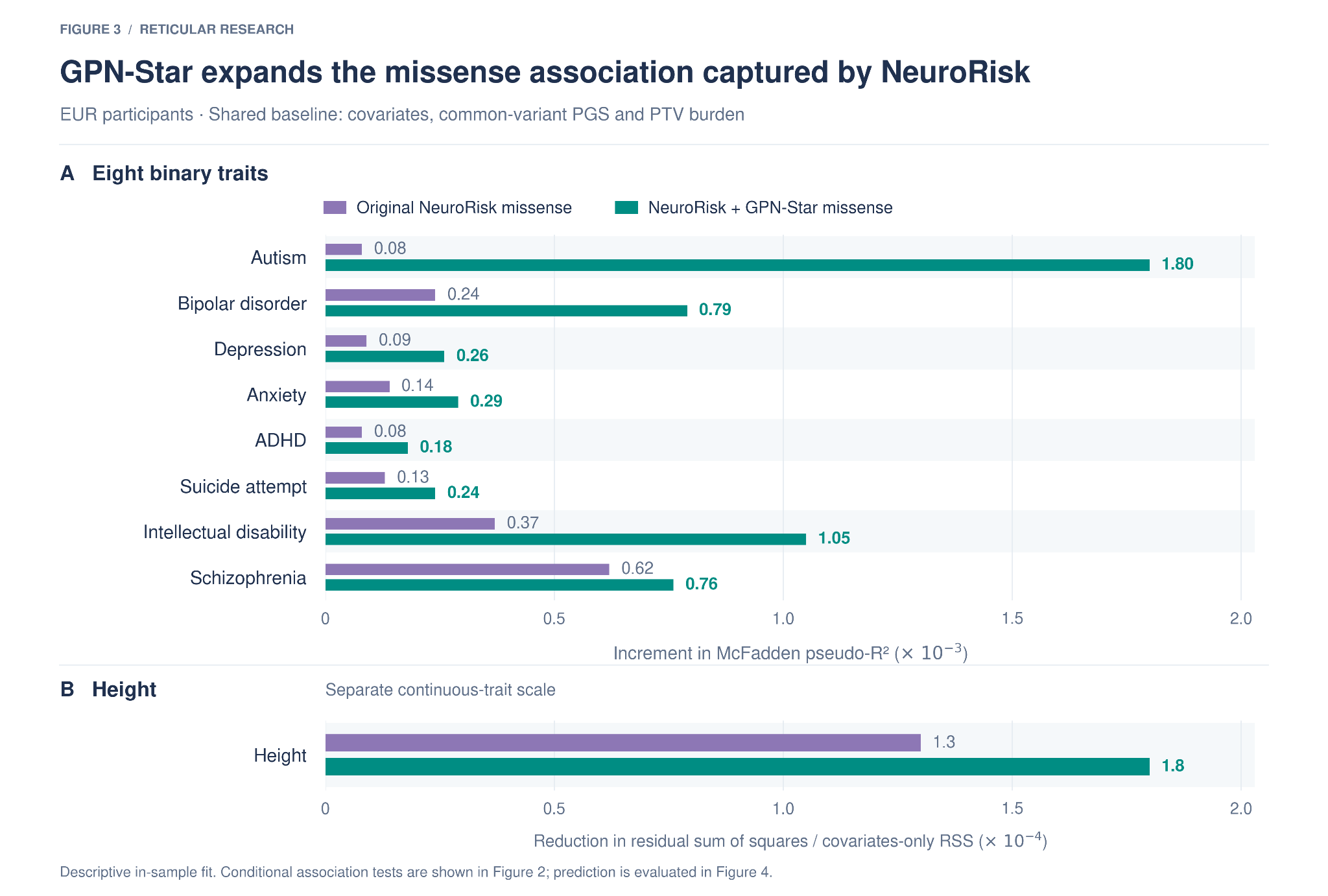
We next sought to test whether expanding missense selection captured additional association beyond the original NeuroRisk burden. Because our intervention modifies missense selection rather than protein-truncating burden, we compared the original and expanded missense representations against a common baseline containing PGS, PTV burden, and covariates. The original model adds the NeuroRisk damaging-missense burden to this baseline; the expanded model adds both the original burden and a separately estimated GPN-Star rescue component.
For autism, the original NeuroRisk missense burden increased McFadden pseudo-R² by approximately 0.00008 beyond PGS and PTV burden, compared with 0.00180 for the expanded representation. Bipolar disorder showed corresponding increments of 0.00024 and 0.00079. These results quantify the additional fitted association captured by expanding missense inclusion; out-of-fold predictive performance is evaluated separately below.
Small internal predictive gains for selected traits
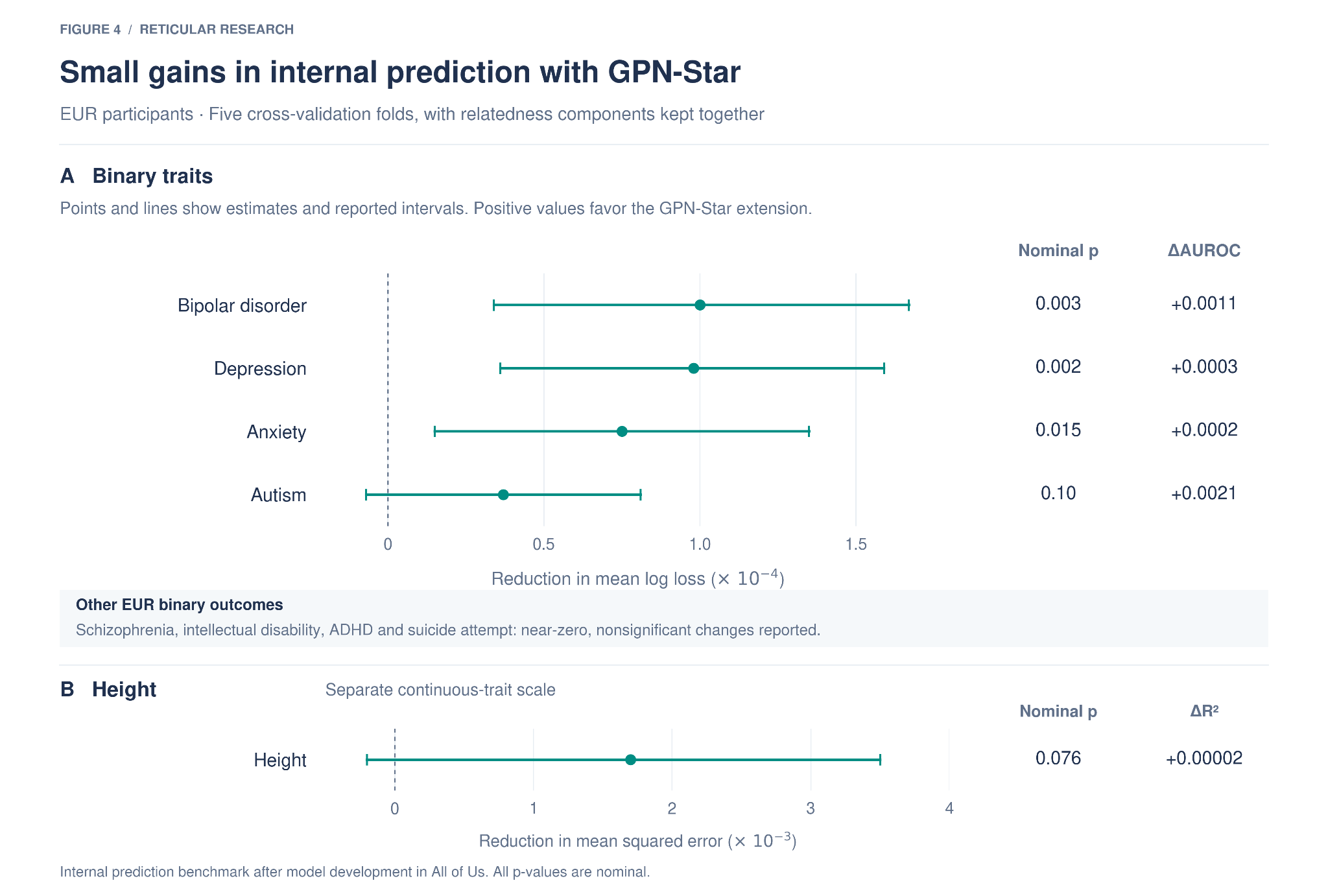
We next tested whether adding the rescue burden improved prediction in an internal cross-validation benchmark. We used five family-component-aware folds and paired out-of-fold predictions to compare the original PGS-plus-NeuroRisk model with the GPN-Star-extended model. In EUR participants, adding GPN-Star variants reduced mean log loss by 0.000100 for bipolar disorder, 0.000098 for depression, and 0.000075 for anxiety, with nominal p-values of 0.003, 0.002, and 0.015, respectively. The corresponding AUROC changes were +0.0011, +0.0003, and +0.0002. The absolute gains were small, but they provide internal evidence that the expanded missense representation can contribute information beyond the existing predictors. The autism log-loss estimate favored the extension, but its interval included zero (p = 0.10); the same was true for height on the mean-squared-error scale (p = 0.076). The remaining EUR outcomes showed near-zero, nonsignificant changes. AFR and AMR benchmarks did not show a consistent predictive benefit.
These findings extend the association analysis to an internal prediction benchmark. They do not establish external validity or clinical utility: the hypothesis was developed using overlapping cohort data, and performance remains to be evaluated in an independent setting.
Discussion and Outlook
Our results suggest that an important limitation of rare-variant burden models lies in which variants are included in the first place. NeuroRisk demonstrates the utility of gene-level evolutionary constraint for aggregating rare damaging variation. However, its strict variant thresholds necessarily exclude a substantial portion of rare coding variation. We used GPN-Star, a genomic language model, to extend this rare variant framework, identifying a complementary missense burden associated with seven of nine traits in European-ancestry participants after adjustment for common-variant polygenic scores and established NeuroRisk burdens. Height showed consistent association directions across EUR, AFR and AMR participants, while other phenotypes exhibited less consistent evidence. These differences may reflect ancestry-dependent genetic architecture, differences in rare-variant exposure, phenotype ascertainment or statistical power. Larger and more diverse sequencing cohorts will be important for determining the portability of these findings.
The additional associations translated into small internal predictive gains for bipolar disorder, depression, and anxiety. Their generalization remains to be established in independent data. Furthermore, identifying additional associated burdens does not establish that GPN-Star is uniquely superior at ranking the functional consequences of individual missense variants. For bipolar disorder, the persistence of association in matched within-gene selections suggests that part of the added signal may arise from a principled expansion of the set of included variants, rather than from superior ordering of individual missense variants by GPN-Star.
These findings demonstrate how genomic AI can help expand the representation of rare coding variation in genetic prediction models. At Reticular, we are also investigating whether structural variants and other forms of genetic variation provide complementary information beyond common-variant polygenic scores and rare coding-variant burdens. Our goal is to build increasingly comprehensive genetic prediction models by integrating information across the genome, while rigorously evaluating predictive performance and generalizability.
All analyses were performed in the All of Us Research Program Controlled Tier dataset version 9 using the Research Workbench (C2025Q4R6). We gratefully acknowledge All of Us participants for their contributions, without whom this research would not have been possible. We also thank the National Institutes of Health’s All of Us Research Program for making available the participant data examined in this study.
References
- Ahangari, Mohammad, et al. "Exome-wide rare variant genetic load is associated with cognition, intellectual disability and psychiatric disorders in population-based cohorts." medRxiv (2026): 2026-10.
- Ye, Chengzhong, et al. "Predicting genome-wide functional constraints with GPN-Star." Nature (2026): 1-10.
- All of Us Research Program Investigators. "The “All of Us” research program." New England Journal of Medicine 381.7 (2019): 668-676.
- All of Us Research Program Genomics Investigators. "Genomic data in the all of us research program." Nature 627.8003 (2024): 340-346.
- Schubach, Max, et al. "CADD v1. 7: using protein language models, regulatory CNNs and other nucleotide-level scores to improve genome-wide variant predictions." Nucleic acids research 52.D1 (2024): D1143-D1154.
- Ioannidis, Nilah M., et al. "REVEL: an ensemble method for predicting the pathogenicity of rare missense variants." The American Journal of Human Genetics 99.4 (2016): 877-885.
- Cassa, Christopher A., et al. "Estimating the selective effects of heterozygous protein-truncating variants from human exome data." Nature genetics 49.5 (2017): 806-810.
- Sun, Kathie Y., et al. "A deep catalogue of protein-coding variation in 983,578 individuals." Nature 631.8021 (2024): 583-592.
- Karczewski, Konrad J., et al. "The mutational constraint spectrum quantified from variation in 141,456 humans." Nature 581.7809 (2020): 434-443.
- Antaki, Danny, et al. "A phenotypic spectrum of autism is attributable to the combined effects of rare variants, polygenic risk and sex." Nature genetics 54.9 (2022): 1284-1292.
- Urpa, Lea, et al. "Evidence for the additivity of rare and common variant burden throughout the spectrum of intellectual disability." European Journal of Human Genetics 32.5 (2024): 576-583.
- Liu, Dongjing, et al. "Schizophrenia risk conferred by rare protein-truncating variants is conserved across diverse human populations." Nature genetics 55.3 (2023): 369-376.