
Patient guide
Better Genetic Risk Scores for Autism and Other Neuropsychiatric Conditions
Reticular combines common and rare genetic variants to capture information that a common-variant polygenic score can miss

Reticular Team
Research Team

Reticular's genetic scores help identify people with greater genetic susceptibility to certain conditions from their DNA. By combining common and rare DNA variants, we’ve improved our genetic risk scores for four neuropsychiatric conditions: autism, schizophrenia, bipolar disorder, and intellectual disability. In a large research study, diagnoses were more common in the highest-scoring 5% for each combined score than in the top 5% ranked by common variants alone.
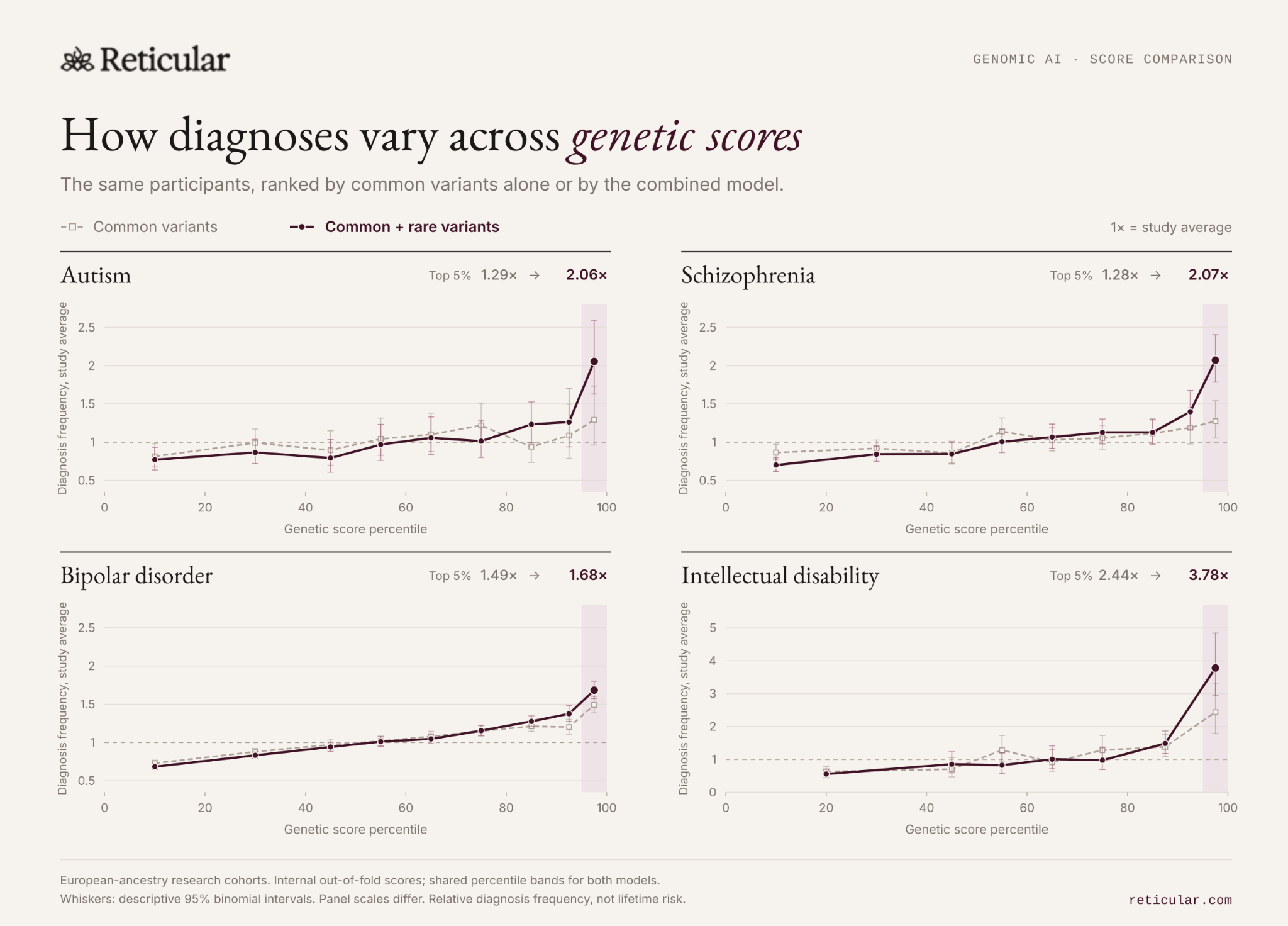
Diagnosis rates reached about 4x the study average
For each condition, we ranked the same participants using the common-variant-only score and the combined score, then examined each score’s highest-scoring 5%. The combined score identified groups with higher recorded diagnosis frequencies:
- Intellectual disability: about 4× as often as average, up from 2.4× before
- Autism: about 2× as often, up from 1.3×
- Schizophrenia: about 2× as often, up from 1.3×
- Bipolar disorder: about 1.7× as often, up from 1.5×
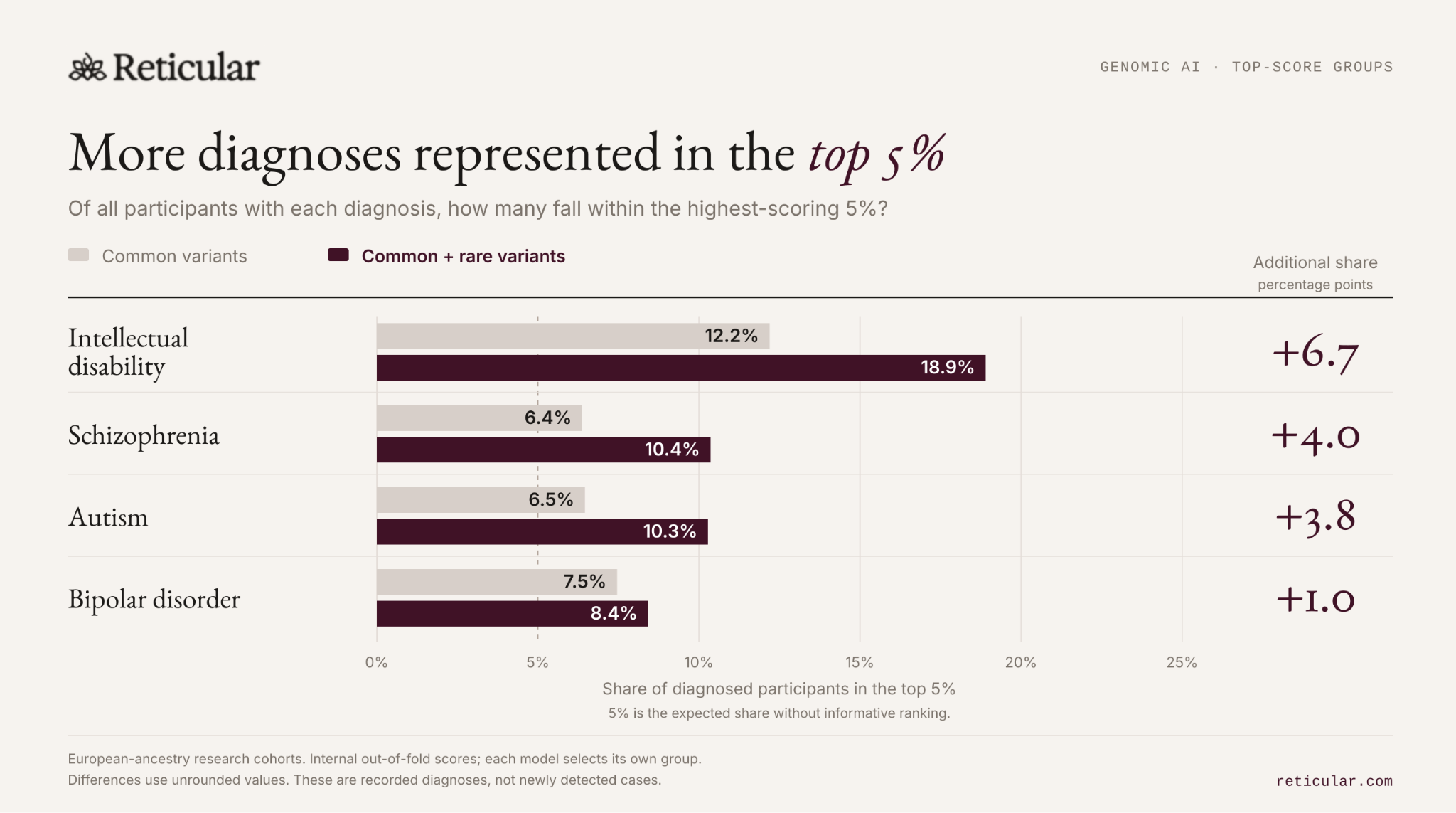
More people with a diagnosis ranked in the top 5%
Another way to look at it: of everyone with a diagnosis, how many did each score place in its top 5%? For autism, the combined score placed about 1 in 10 people in this group, up from about 1 in 16 using common variants alone. Schizophrenia showed a similar increase. For intellectual disability, the share rose to about 1 in 5, up from about 1 in 8. Bipolar disorder improved more modestly.
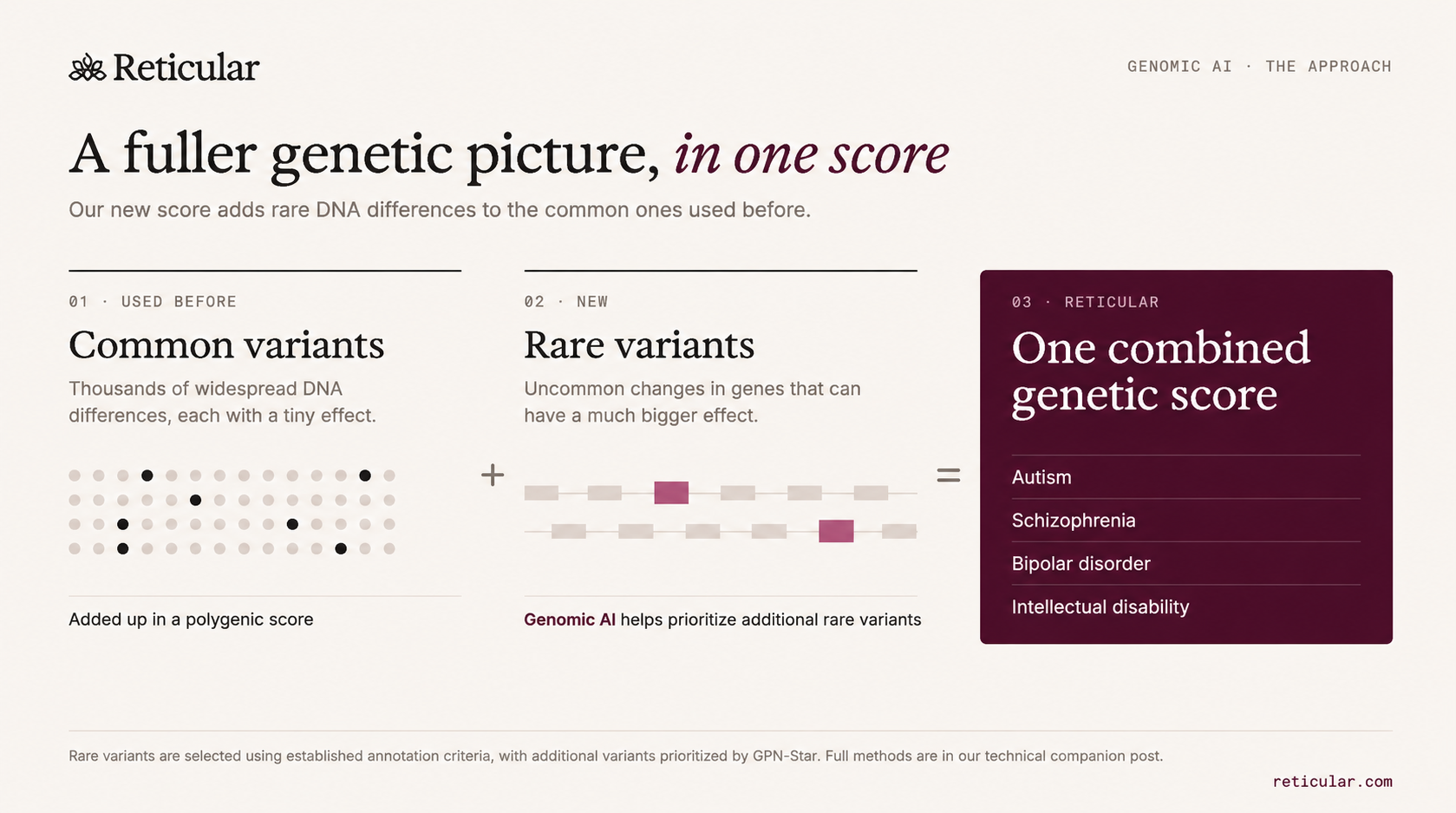
What changed
Traditional polygenic scores mainly use common DNA differences with small individual effects. Our new scores also include selected rare variants, which are uncommon but can have larger effects. We use genomic AI to help prioritize additional rare variants that may affect biological function. For details on the rare-variant approach and the common-variant scores used in each analysis, read our technical companion post.
What this means for your family
A genetic score estimates risk. It isn't a diagnosis. A higher score means higher odds of a condition, not a certainty, and many people with these conditions don't have high scores. Genetics is also only part of the picture: environment and chance matter too. Our genetic counselors can walk you through what a score means for your family.
About this analysis
These results describe recorded diagnoses in adults of European ancestry in the All of Us Research Program. They evaluate the full combined score, not genomic AI alone, and do not estimate individual lifetime risk. Performance in children and other populations requires further validation. These figures use an updated common-variant baseline covering approximately 7.7 million variants, compared with approximately 1 million in the technical companion post. Both the common-variant-only and combined scores use this updated baseline. We gratefully acknowledge All of Us participants for their contributions, without whom this research would not have been possible. We also thank the National Institutes of Health’s All of Us Research Program for making available the participant data examined in this study.
References
- Ahangari, Mohammad, et al. "Exome-wide rare variant genetic load is associated with cognition, intellectual disability and psychiatric disorders in population-based cohorts." medRxiv (2026): 2026-10.
- Ye, Chengzhong, et al. "Predicting genome-wide functional constraints with GPN-Star." Nature (2026): 1-10.
- All of Us Research Program Investigators. "The “All of Us” research program." New England Journal of Medicine 381.7 (2019): 668-676.
- All of Us Research Program Genomics Investigators. "Genomic data in the all of us research program." Nature 627.8003 (2024): 340-346.
- Schubach, Max, et al. "CADD v1. 7: using protein language models, regulatory CNNs and other nucleotide-level scores to improve genome-wide variant predictions." Nucleic acids research 52.D1 (2024): D1143-D1154.
- Ioannidis, Nilah M., et al. "REVEL: an ensemble method for predicting the pathogenicity of rare missense variants." The American Journal of Human Genetics 99.4 (2016): 877-885.
- Antaki, Danny, et al. "A phenotypic spectrum of autism is attributable to the combined effects of rare variants, polygenic risk and sex." Nature genetics 54.9 (2022): 1284-1292.
- Urpa, Lea, et al. "Evidence for the additivity of rare and common variant burden throughout the spectrum of intellectual disability." European Journal of Human Genetics 32.5 (2024): 576-583.
- Liu, Dongjing, et al. "Schizophrenia risk conferred by rare protein-truncating variants is conserved across diverse human populations." Nature genetics 55.3 (2023): 369-376.