
For egg banks, sperm banks & donor agencies
Screen donors for genes behind IVF failure and pregnancy loss.
One cheek swab, on top of the screening you already do. Results in three weeks, explained by a genetic counselor.
Loss happens even with gamete donors.
Some causes are untested genetic factors. Better to find them at screening than after a loss.
Each rate comes from a separate study of donor-egg IVF. Transfer outcomes are for recipients aged 35 to 50.
One cheek swab
At the screening visit or at home
Results in three weeks
Explained by a genetic counselor
$399 per donor
Your first 5 donors free
From · Published in · Backed by

$4.3M seed — led by CRV and BoxGroup. Y Combinator alumni.
How it works.
Step 01
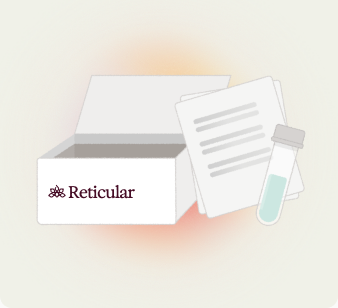
Donors swab at screening
One cheek swab at the screening visit, or a home kit.
Step 02
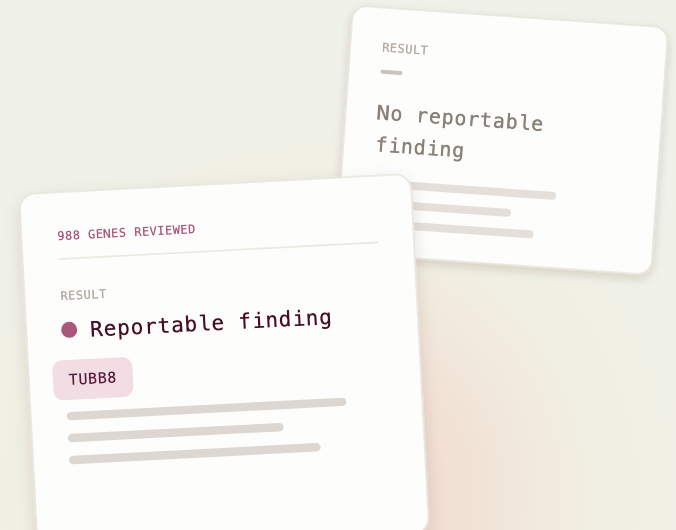
We screen 988 genes
Whole-genome sequencing, with results in three weeks.
Step 03
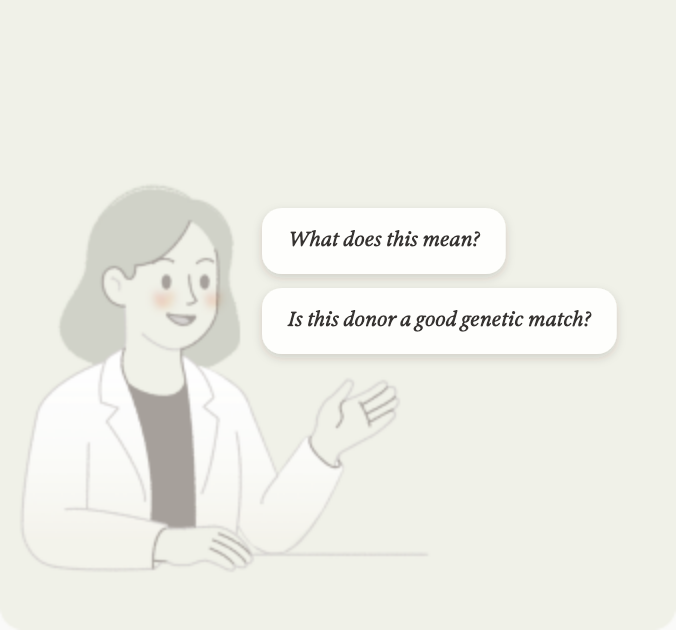
We explain every result
Genetic counseling for the donor, your team and intended parents.
When to screen
Screen at intake, or later in your process.
A cheek swab at an in-person screening visit, or a home kit. Either way, each donor is screened once.
Cheek swab
At a visit or by home kit
Results in 3 weeks
On the donor’s record
Every match
Screened once, no retest
What’s different
The genes that expanded carrier screening skips.
Carrier screening checks what a child could inherit. Reticular checks the donor’s own genes for gamete maturation, fertilization and embryo development.
Your screening today
Medical, genetic and psychological
- Infectious disease
- Carrier screening
- AMH · semen analysis
Reticular adds on top
The donor’s own egg and sperm genes
988 genes across egg maturation, fertilization, embryo development, sperm function and pregnancy support
Checked against 10 carrier screens
653 genes
that no carrier screening includes, such as
- TUBB8
- PATL2
- PLCZ1
Why these genes matter.
Egg donors
Embryo quality starts with egg maturation.
Variants in maturation genes like TUBB8 and PATL2 show up downstream: eggs that don’t fertilize, embryos that stop growing, transfers that don’t implant.
47%
of genetically diagnosed egg and embryo failures traced to one gene, TUBB8.
Chen et al., Cell Genomics 2026Zhao et al., J Assist Reprod Genet 2020
Sperm donors
Semen analysis can’t see fertilization failure.
PLCZ1 lets sperm activate the egg. Men with PLCZ1 variants can have a normal semen analysis, and one donor can help 25 US families. Screening can find it first.
29%
of men with fertilization failure after ICSI carried a PLCZ1 variant.
Cardona Barberán et al., Hum Reprod Open 2024Yan et al., Hum Reprod 2020
The other half of the match
Screen the intended parents, too.
Carrier screening pairs a donor’s result with an intended parent’s. This works the same way: the parent providing the egg or sperm can be screened on the same panel, and the two results are read together.
$399 on its own, or $749 together with the donor.
For an intended father, a finding gives his clinic something to act on.
11% to 64%
fertilization before and after assisted oocyte activation, in men with PLCZ1 variants.
For your program
What your program gets.
A new answer for intended parents
Each donor screened for the genes behind egg and sperm function.
Answers when a cycle falls short
A result on file helps explain poor fertilization or stalled embryos.
Something for donors, too
Their own report, explained by a genetic counselor.
Outcomes you can follow
Results stay on each donor’s record, to compare over time.
Program pricing
One screen per donor, for every family they help.
$399per donor
$749 for a donor and an intended parent together
- Genetic counseling included
- Volume pricing for programs
- Your first 5 donors free
Gamete Donor Screening runs on the Infertility & Pregnancy Loss Panel, the same test families order from Reticular.
Once
Each donor is screened one time, and the result is on file for every match.
1–2%
of what one family pays for donor eggs.
Programs order and pay. Donors are not charged.
40+
donors screened for the price of one replacement set of donor eggs.
If your program replaces sets that don’t lead to a usable embryo, one replacement avoided covers 40 donors.
Common questions
Questions, answered.
No. Results inform matching and counseling, the way carrier results do. Your acceptance criteria stay yours.
Most donors will have no reportable finding. When there is one, it counts: these genes are established causes of failed fertilization and stalled embryos in IVF patients, and a donor’s result carries to every family they help. Your own donors’ results will show your program’s rate of reportable findings.Chen et al., Cell Genomics 2026Cardona Barberán et al., Hum Reprod Open 2024
It adds to it. Carrier screening asks what a child could inherit. Reticular looks at the donor’s own genes for egg and sperm function. Currently, the panel does not replace standard carrier screening.
The same people who see carrier screening results today. The donor gets the report and a session with a genetic counselor, your program gets the results, and intended parents see them when they are choosing or matched with that donor.
No. Results are back in three weeks, so a donor screened at intake has them on file before listing. Donors already in your program can swab at a visit or use a home kit.
No. It is screening, not a diagnosis. A result with no reportable finding covers the genes tested, not every cause of a failed cycle or a loss.
Who you’ll talk to

Christina Ren, MS, CGC
Chief Product Officer
Stanford — board-certified genetic counselor. Previously at Orchid.

John Yang
Co-founder & CEO
MIT — computational biology. Published in Nature and NeurIPS.
Contact
Let’s find a time that works for you.
A 30-minute call, or a sponsored lunch-and-learn on how Reticular fits into your workflow.