One partner
$250

After pregnancy loss
Affordable genetic testing from $23/mo†. Get answers with confidence, risk-free.
Screen 750+ reproductive genes at home, with counseling included.
Choose checkout
$250
$500
Results are informational and do not diagnose a condition, explain every pregnancy loss, recommend treatment, or guarantee an outcome.
Payment options through Affirm are subject to eligibility and may require a down payment.

No reportable finding? Full refund.
Available only when the completed report has no qualifying result under the published product terms. Request during your included results call.
Eligibility termsat-home saliva sample
No clinic visit required
Results in about 3 weeks
After samples reach the lab
Counseling included
Review findings with a counselor
What happens next
From checkout to results, here’s what happens after you choose a plan.
Step 01
Choose one or both partners. We ship each person a saliva kit with everything needed to return it.

Step 02
After you send the kits back, the lab sequences and reviews reproductive genes.
Step 03
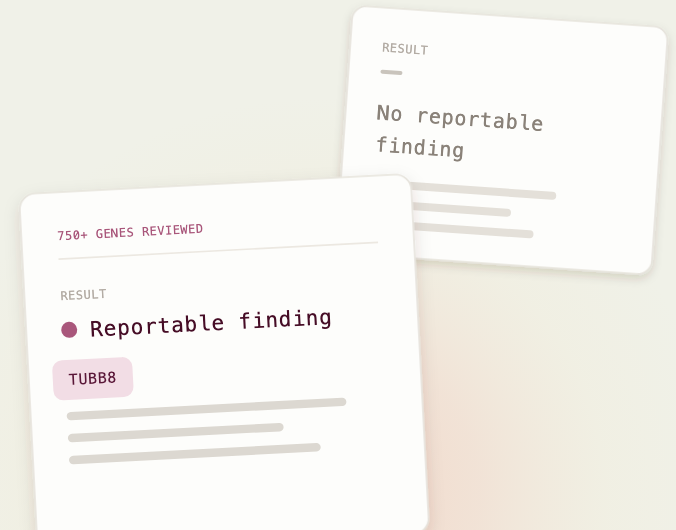
See findings in plain language, then talk them through with a genetic counselor and your care team.
How Reticular can help
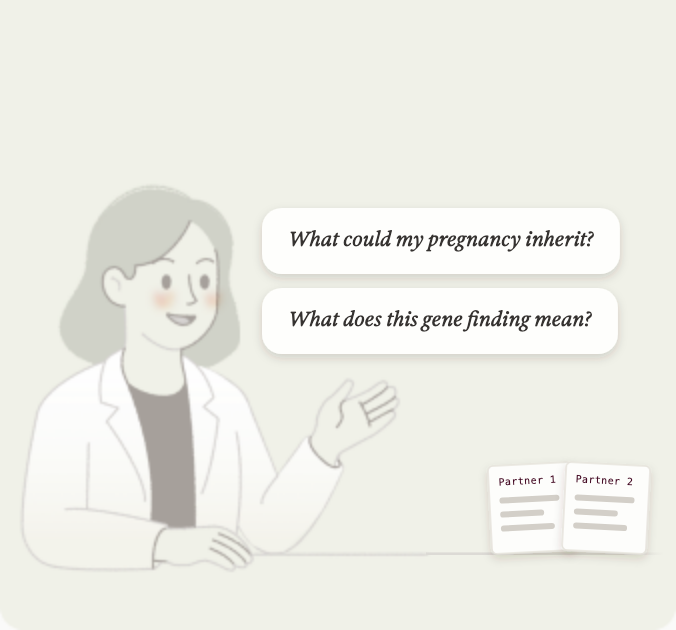
Christina walks through an illustrative report, explains where to begin, and separates the main finding from supporting context and possible next steps.
Guided sample report
Christina explains how to read the main finding, partner results, counselor context, and possible next steps.
Educational example only. Your results and next steps will depend on your history and care team.
Sample report
Explore illustrative findings, inheritance context, and a counselor’s interpretation. The report informs a conversation—it does not diagnose or predict.
Explore at your own pace
Partner results
Egg source
TUBB8
May help explain repeated early losses.
Also found: DHCR7 carrier result — lower relevance to the losses.
Sperm source
PLCZ1
May affect the sperm’s ability to activate the egg after fertilization.
Genetic counselor review

Reviewed by Christina, Genetic Counselor
Your report found a change in TUBB8, a gene that helps eggs mature and supports the embryo’s earliest development. Findings like this can sometimes help explain repeated early losses that standard chromosome testing misses.
Nothing about how you tried to conceive caused these losses.
Your care team can use this information to discuss next steps with you.
What the panel screens
750+
genes
Grouped by what each gene does in reproduction.
TUBB8 · PATL2
WEE2 · PLCZ1
BTG4 · PADI6
NLRP7 · KHDC3L
CPLANE1 · DYNC2H1
F5 · SERPINC1
CFTR · AURKC
Representative groups and genes from the full panel.
1 of 3
Illustrative example. Your findings and recommendations will depend on your results and clinical history.
Evidence and boundaries
Reticular's reviewed patient resources explain how reproductive-gene screening differs from chromosome testing, carrier screening, and the broader recurrent-loss evaluation.
Common questions
It screens one or both intended parents across 750+ genes associated with fertility, early embryo development, and recurrent pregnancy loss. It analyzes a saliva sample from the parent or parents, not an embryo or a prior pregnancy.
Not in every case. A well-supported finding may identify a reproductive-gene factor worth discussing with your care team, but the panel does not explain most individual losses, diagnose a cause, or predict whether a future pregnancy will succeed.
A karyotype examines chromosome number and structure. Carrier screening primarily asks whether a future child could inherit certain conditions. This panel examines individual reproductive genes associated with fertility and pregnancy viability, so the tests answer different questions and may be used alongside one another.
No. The panel does not replace pregnancy-tissue testing, parental karyotyping, carrier screening, or evaluation of uterine, hormonal, clotting, immune, and other possible contributors to recurrent loss.
Either option is available. Screening both partners provides a combined view of each person’s reproductive-gene findings. A genetic counselor can help you decide which option fits your history and any testing you have already completed.
A negative result means the panel did not identify a reportable finding under its current methods and evidence standards. It does not rule out every genetic factor or other possible reason for infertility or pregnancy loss.
Yes. A genetic counselor helps place the report in context, explains what a finding does and does not mean, and helps you prepare questions for your fertility clinician or other care team.
A human next step
Text our team for a quick product question, or book a complimentary conversation with Christina, our licensed genetic counselor, to discuss your history, prior testing, and whether one- or two-partner screening fits.
Reticular also offers embryo reports that use compatible PGT-A data you already have, with no new embryo biopsy.