
Reticular

After PGT-A

Know which embryos carry higher risk for 24+ conditions.

Use the PGT-A data you already have to screen every embryo for 24+ health conditions and the genes behind pregnancy loss—without another biopsy.

We confirm your data is compatible before you pay

Embryo Report · Complete

One flat fee for every embryo you have across every cycle.

Both partners + your embryo data

$1,000

  • 24+ health conditions and traits, compared across every embryo
  • Pregnancy-loss genes checked in every embryo and both partners
  • Genetic counseling and downloadable data included

No reportable finding? Full refund. Available only when the completed report has no qualifying result under the published product terms.

Eligibility terms

Results do not diagnose a condition, predict whether a child will develop one, or guarantee an outcome.

Payment options through Affirm are subject to eligibility and may require a down payment.

  • No new biopsy

  • Counselor review

  • Pay over time

Two Embryo Reports. Same data, different scope.

Your PGT-A report answers one question — chromosomes. Both Reports read that same data for more.

Embryo Report · Core

Pregnancy loss only

$750

  • Chromosome result for every embryo
  • Pregnancy-loss and fertility genes
See Embryo Core

Embryo Report · Complete

Pregnancy loss + health

$1,000

  • Everything in Core
  • 24+ health conditions and traits, compared across every embryo
Get Embryo Complete

What happens next

How Embryo Complete works

No new biopsy, and a counselor walks you through the result.

  1. Step 01

    Both partners test at home

    We ship two saliva kits to screen you both across 750+ genes, and send you the exact request for your embryos' PGT-A file — written for your lab.

    Reticular test kit, papers, and sample vial.
  2. Step 02

    We score every embryo

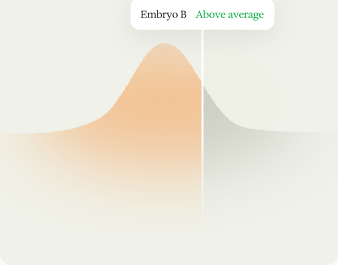
    Read against both partners' genomes, your embryos' existing PGT-A data shows which pregnancy-loss genes each one inherited, then places each on a risk curve per condition.

    Embryo scoring curve with one embryo marked above average.
  3. Step 03

    We explain the report

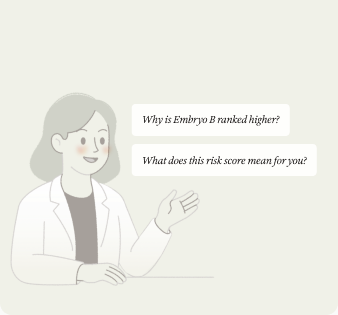
    A genetic counselor goes through every embryo with you — what each score means, and what it doesn't.

    Genetic counselor explaining embryo results, asked why one embryo ranked higher and what a risk score means.

Sample report

Pregnancy loss and lifelong health, for every embryo.

The same report Core gives you, plus a score for every condition on the list.

Embryo report · comparison

Scored conditions, side by side

Sample scores for three conditions across five embryos
ConditionE4E2E7E6E5
Type 1 diabetes
-24%
-80%
+32%
+56%
+29%
Glaucoma
-32%
-48%
+10%
+43%
0%
Prostate cancer
-35%
-95%
-26%
-50%
+22%

Takeaway

Embryo 2 scores lowest on all three. The report ranks by the priorities you set, so which risks matter most is your call.

Embryo report · pregnancy loss

Embryo 7 is euploid, with a TUBB8 finding

EuploidHigher risk

TUBB8

Established

c.686T>C (p.Val229Ala) · Maternal-effect

Published pathogenic variant linked to oocyte maturation defect and early embryo arrest.

Context

Chromosomally normal, and still a finding — a chromosome count cannot see this.

Embryo report · polygenic score

Type 1 diabetes in five sibling embryos

Example resultIntended father diagnosed — type 1 diabetes

-80%

Embryo 2 · lowest

+56%

Embryo 6 · highest

Lower riskHigher risk

Each dot is one embryo. The centre line is this family's baseline.

Why this matters

Sibling embryos from the same two parents can carry very different risks of developing the same condition. A polygenic score is what shows the difference.

View the full sample report

Illustrative example. Your findings and recommendations will depend on your results and clinical history.

Embryo Report · Complete

Every finding, in one report.

24 findings per embryo
1 pregnancy-loss screen + 23 scored conditions

Pregnancy loss

Also in Core
750+ gene panel · both partners

One result per embryo: its chromosome result, plus any pregnancy-loss gene fault it inherited from the 750+ genes screened in both of you.

  • No known risks
  • Moderate risk
  • Higher risk

Health conditions and traits

23 conditions · scored per embryo

Heart & blood

  • High blood pressure
  • Dyslipidemia
  • High cholesterol
  • Coronary artery disease
  • Atrial fibrillation
  • Red blood cell count

Immune & respiratory

  • Allergies or eczema
  • Asthma
  • Inflammatory bowel disease
  • Celiac disease
  • Type 1 diabetes

Cancer

  • Basal cell skin cancer
  • Breast cancer
  • Prostate cancer
  • Melanoma

Bone & joint

  • Osteoporosis
  • Bone mineral density
  • Gout

Brain & mind

  • Alzheimer's disease
  • Migraine
  • Schizophrenia

Eye & vision

  • Glaucoma
  • Myopia

Scores estimate genetic predisposition against a reference population. Non-genetic factors shape health too.

Common questions

How each embryo is ranked, and how a modeled risk estimate differs from a diagnosis. Read the full method.

Complete includes everything in Core — each embryo's chromosome result, a pregnancy-loss and fertility gene review, and the full 750+ gene panel for both partners — and adds modeled risk estimates for 24+ health conditions and traits on every embryo. Genetic counseling and downloadable data are included.

Core focuses on pregnancy-loss and fertility findings for $750. Complete is $1,000 and includes everything in Core, then adds 24+ health conditions and traits for every embryo.

No new biopsy or test is needed — we use the PGT-A data from your already-tested embryos. Compatibility depends on how your embryos were sequenced, so we review your files and confirm before you pay anything for embryo analysis.

Our models are trained on individual-level genomes from large biobanks, not the GWAS summary statistics behind most polygenic scores. We then test the question your report actually asks: does the score separate sibling embryos, not just unrelated people? Complete is $1,000 for all embryos, all cycles; comparable reports elsewhere run $10,000 or more.

No. A score estimates genetic predisposition relative to a reference population. It is not a diagnosis and not a prediction of whether a child will develop a condition. Diet, environment, chance, and factors no genetic model captures all matter, and no embryo-ranking scheme is validated by prospective outcome data yet.

Most published polygenic research is on people of European ancestry, so that is where scores have historically been strongest. We train and validate across several biobanks — including NIH's All of Us, built specifically to redress that gap — using methods designed to carry across ancestries, and this is improving quickly. Your counselor will tell you what it means for your report.

Your report ranks every embryo by best fit for transfer — chromosome result first, then pregnancy-loss genes, then the health conditions weighted by the priorities you set — with a counselor note on each. The decision is yours, made together with your care team.

No. $1,000 is a flat fee covering every embryo you have, across every cycle, with no per-embryo pricing.

It means the review found no reportable finding under current methods and evidence standards. It does not rule out every genetic factor or guarantee that a transfer will succeed. An eligible order with no qualifying result in either partner can request a full refund under the No-Finding Promise.

A human next step

Questions? Get a real answer from Reticular.

Text us a quick question, or book a free conversation with Christina, our licensed genetic counselor, about your embryo data, what the health conditions do and don't tell you, and whether Complete fits.

Just the pregnancy-loss findings?

Embryo Report Core is $750 and covers chromosomes and pregnancy-loss genes — no scores, no trait predictions.

See Embryo Core

No embryo data yet?

The Infertility & Pregnancy Loss Panel screens both partners from an at-home saliva sample — no IVF needed to start.

Explore the panel
Embryo Report Complete: 24+ Health Conditions From PGT-A Data | Reticular