
Product/Brand Spotlight · Sponsored by Reticular
After recurrent pregnancy loss, what can genetic testing tell you?
The genes standard testing never looks at, and what a new at-home panel can add.
This sponsored Q&A was originally published by Female Health & Fertility.
Read the publisher editionIf you've had more than one loss, you may already have had chromosome testing, a karyotype or carrier screening, and still no answer. Here is what those tests leave out, and what a newer test, until recently available only through research studies, can add.
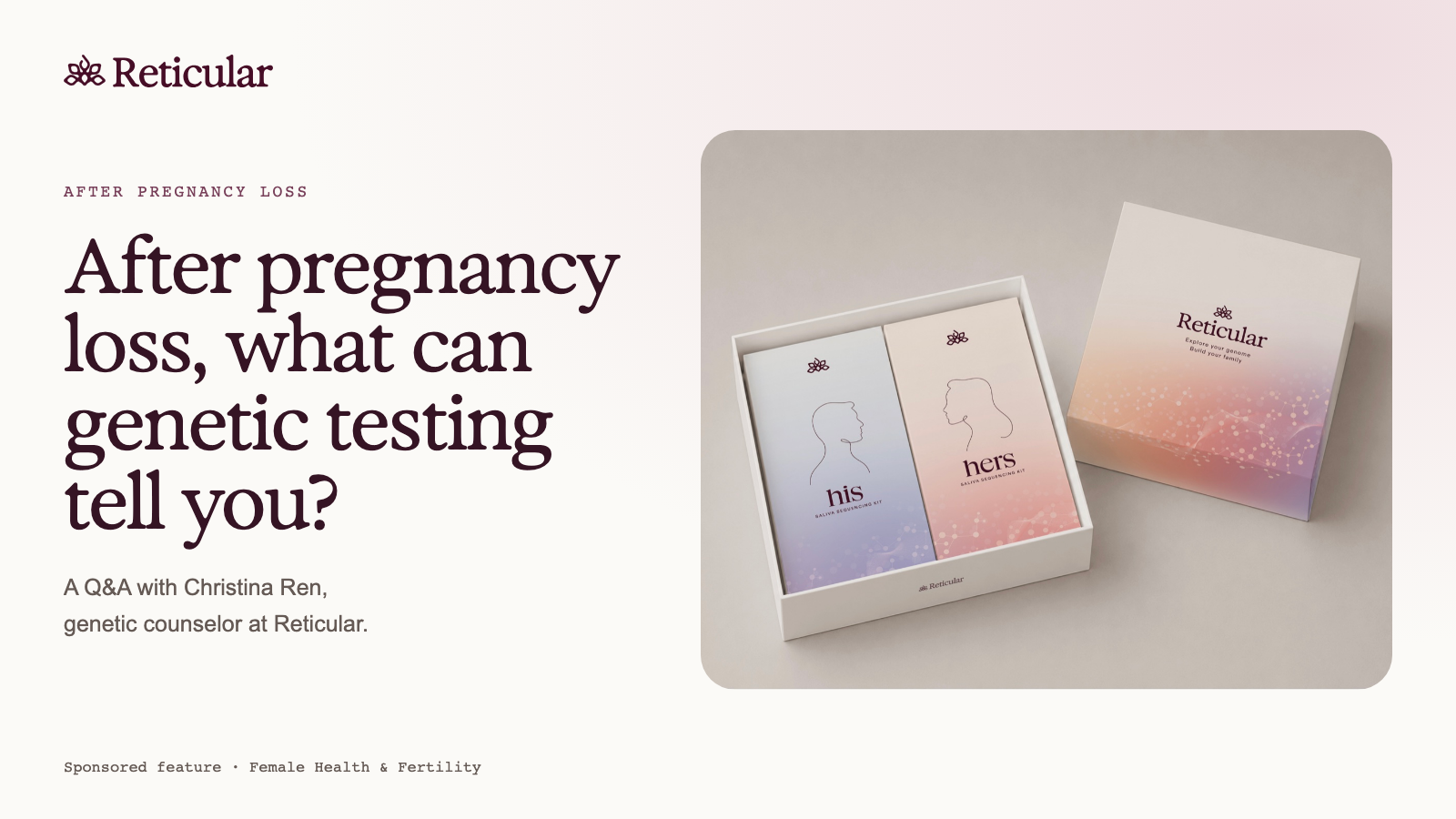
Why do so many pregnancy losses stay unexplained?
When losses are tested, and most aren't, about half trace back to a random chromosomal change in that pregnancy. The other half stay unexplained, and much of the reason is what the standard workup checks: chromosomes, not the individual genes reproduction depends on.
How is this different from the testing I've already had?
Each test you may have had checks something different:
- Pregnancy-tissue testing: the chromosomes of one pregnancy.
- Parental karyotype: the number and structure of your chromosomes.
- Carrier screening: whether a child could inherit certain conditions.
None of them reads the genes that make reproduction work: the ones that build the egg and sperm, allow fertilization and carry an embryo through its first weeks. That is where early losses happen, and none of these tests look there. A reproductive-gene panel reads exactly those genes in you and your partner. Reticular's Infertility & Pregnancy Loss Panel is that test, alongside the others, not in place of them.
Why hasn't my doctor offered this?
Until recently it existed only in research. Single-gene causes of loss have been described for years, but finding them meant enrolling in a genome-sequencing study at an academic center: in a 2025 study from UCSF, Stanford and other centers, sequencing 118 families with unexplained, chromosomally normal recurrent loss found a likely single-gene cause in about 1 in 4 ( Aminbeidokhti et al., 2025). Outside of academic settings, none of these couples would have been offered testing for it. Reticular's panel takes the same approach, in a saliva kit you can order yourself, with a genetic counselor to review the results.
Who is it for?
Anyone with a question standard testing hasn't answered, including:
- two or more early losses
- a loss where the pregnancy tissue tested chromosomally normal
- eggs that don't fertilize, or embryos that stop growing, in IVF
- unexplained infertility
- a molar pregnancy
You don't need to be doing IVF. You can test before your next pregnancy rather than after another loss. The panel covers conception through the first trimester; later losses have a different workup.
How does it work?
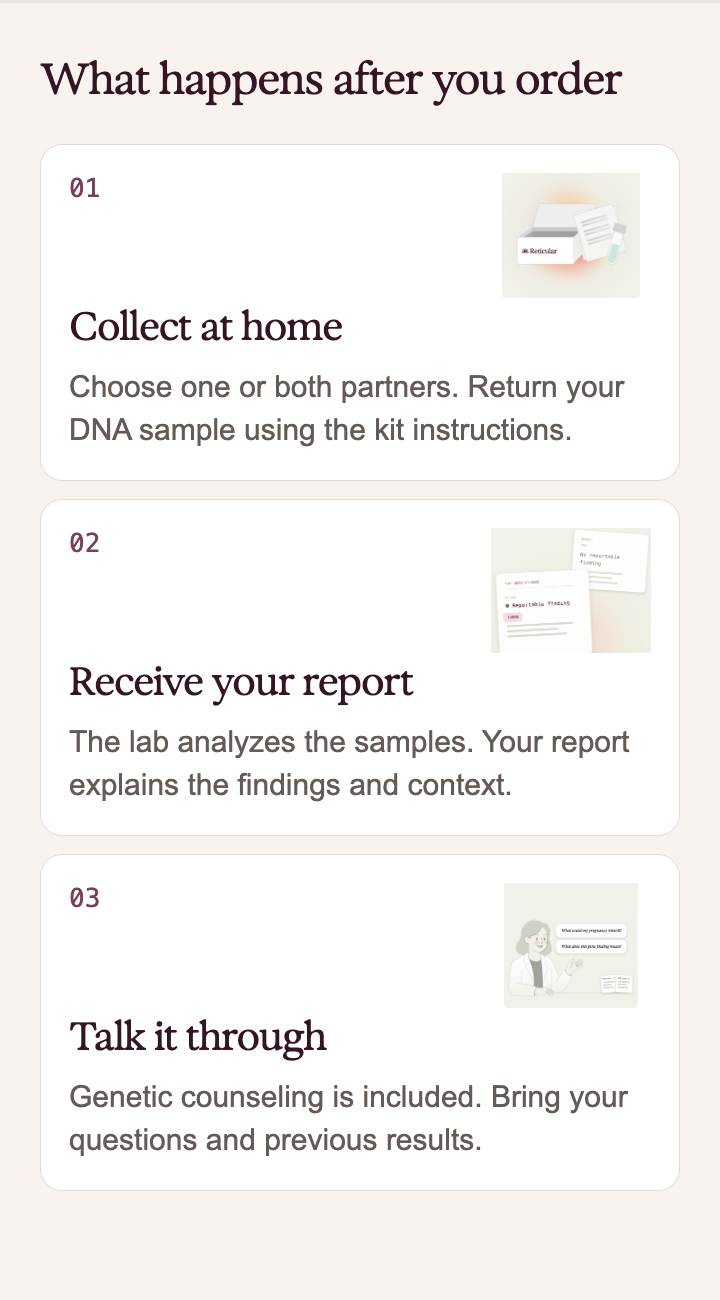
Choose one partner or both. Reticular ships the kit, each person returns a saliva sample, and the lab screens more than 750 genes, from egg and sperm development through fertilization, embryo growth and pregnancy support. You get a plain-language report and a session with a genetic counselor. Testing both partners gives the fullest picture, since some findings matter only when you both carry a change in the same gene.

What will the report show?
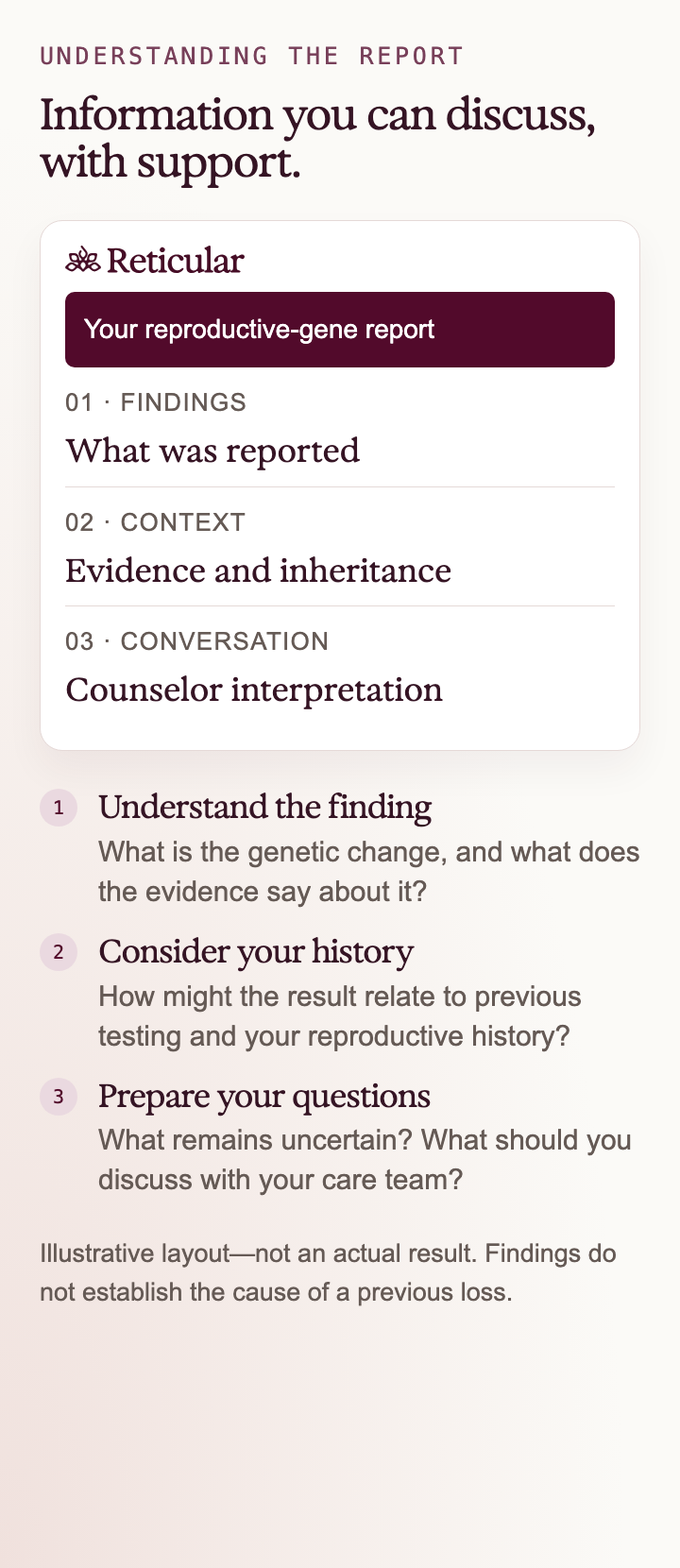
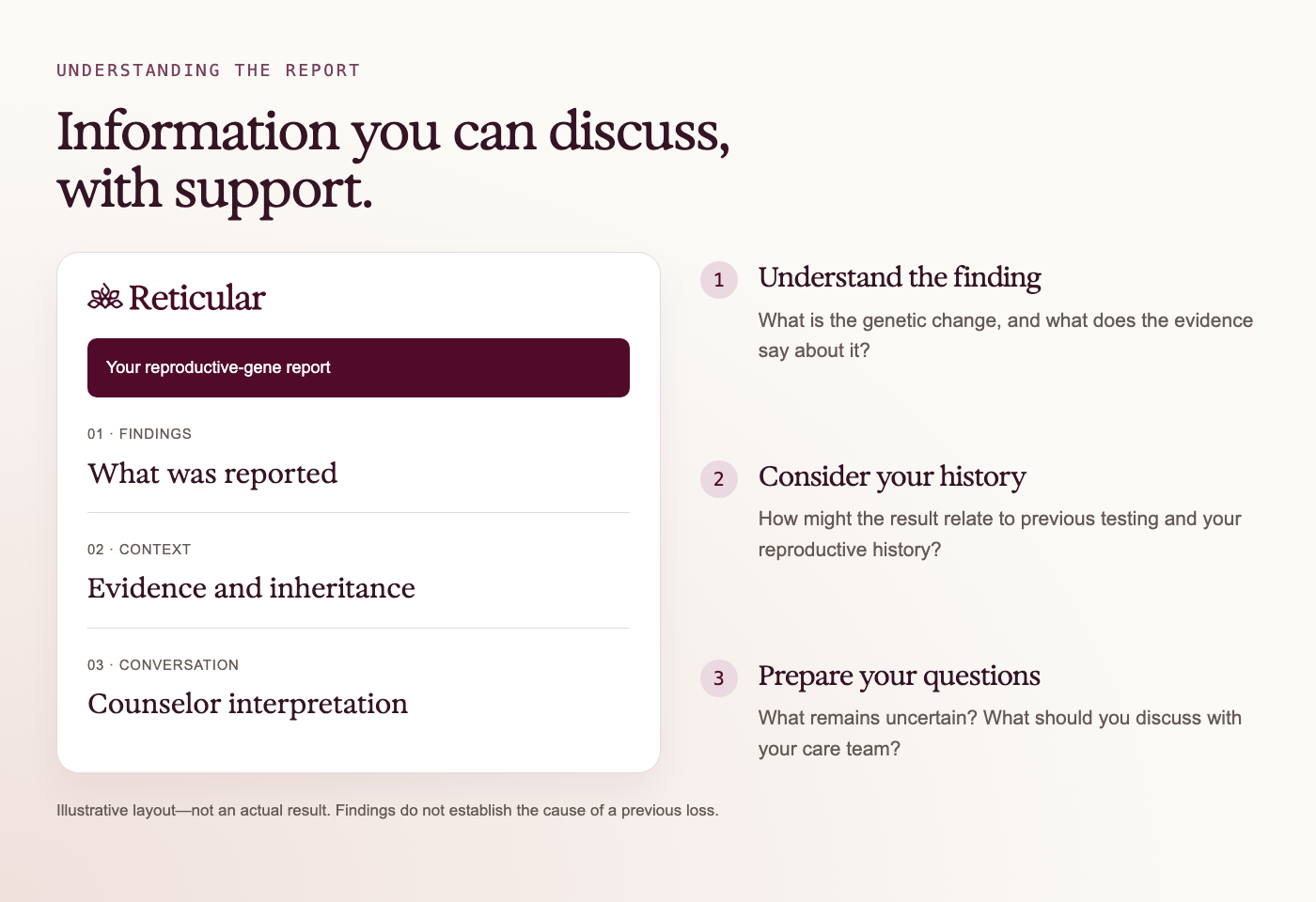
For each partner, either no reportable finding or a short list: the gene, what it does, how strong the evidence is, and how it is inherited. Look at a sample couple's report before you order; it is illustrative, not a real patient.
What can I do with the results?
A finding gives your care team something specific to plan around: closer monitoring in your next pregnancy, such as earlier ultrasounds; OB or reproductive endocrinologist recommendations tailored to the gene; or IVF, where embryos can be screened for the variant and embryos without it prioritized for transfer. Reticular's Embryo Core does that screening from your embryos' existing PGT-A data, no new biopsy, for $1,999. A carrier finding may mean testing your partner or family. Your care team decides what changes.
What can't it tell me?
No reportable finding means nothing was found under the panel's methods and evidence standards, not that all genetic causes are ruled out. It does not diagnose a condition, recommend treatment, or predict whether your next pregnancy will succeed.
What does it cost?
$399 for one partner or $749 for both, report and genetic counseling included; Affirm from $37 a month. Order from the product page, or book a free call with a genetic counselor there first.
Wondering whether a gene could explain your losses?
Whether you've had two losses with no explanation, a loss that tested chromosomally normal, embryos that keep arresting, or you're planning your next pregnancy after loss, Reticular's at-home panel reads the reproductive genes standard testing leaves out, and a genetic counselor goes through the results with you.
Explore the panelReferences
- Aminbeidokhti M, et al.; Rajkovic A. Genetic Variants in Recurrent Euploid Pregnancy Loss. medRxiv (preprint), 2025. doi:10.1101/2025.10.01.25335660
- Practice Committee of the American Society for Reproductive Medicine. Recurrent pregnancy loss: a committee opinion. Fertil Steril. 2026;125:1023–1041.
- ESHRE Guideline Group on RPL. Recurrent Pregnancy Loss: Guideline of the European Society of Human Reproduction and Embryology (2022 update). ESHRE, 2023.