Both partners + your POC data
$999
- Whole-genome sequencing for both partners
- You request the raw data file from your POC lab
- Genetic counseling included

Miscarriage Re-Analysis
After a miscarriage, pregnancy tissue can be tested for chromosome problems. If yours came back normal, we re-analyze your data to look for single-gene causes.
Often called a ‘products of conception’ (POC) test
Both partners' whole genomes, analyzed with the data from your products of conception (POC) testing lab. If the lab can't release a usable file, the report still covers both partners in full (see the Infertility & Pregnancy Loss Panel).
Choose checkout
$999
Results are informational and do not diagnose a condition, explain every pregnancy loss, recommend treatment, or guarantee an outcome.
Payment options through Affirm are subject to eligibility and may require a down payment.
at-home saliva sample
No clinic visit required
Results in about 3–4 weeks
After your samples and POC data reach us
Counseling included
Review findings with a counselor
About 1 in 4 couples with unexplained, recurrent pregnancy loss—two or more losses, all chromosomally normal—had a possible single-gene cause, usually inherited from one or both parents.
Aminbeidokhti et al., medRxiv 2025 (preprint): 30 of 118 families with two or more unexplained losses; 21 of the 30 had pathogenic or likely-pathogenic variants, and 25 of the 30 were inherited.
What happens next
Three steps from checkout to your report.
Step 01
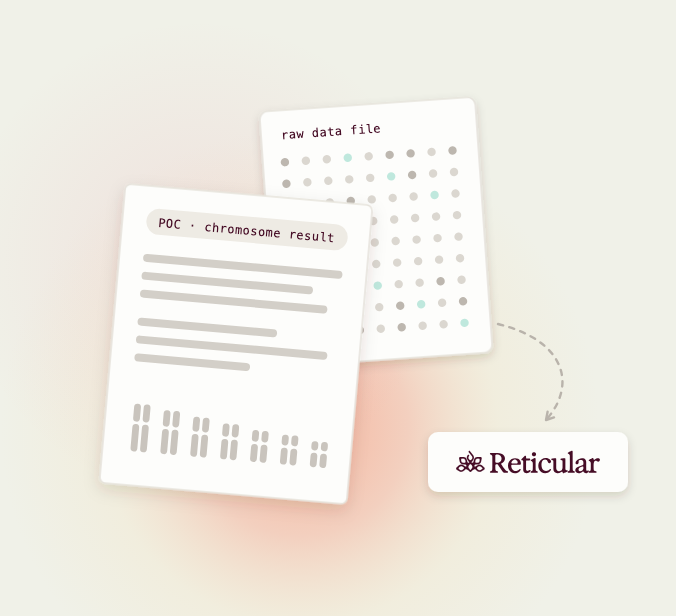
Request the raw data file from the products of conception (POC) testing lab. No new sample, no clinic visit.
Step 02
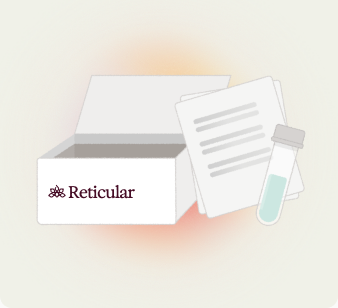
We ship each partner a saliva kit. You send them back to get sequenced.
Step 03
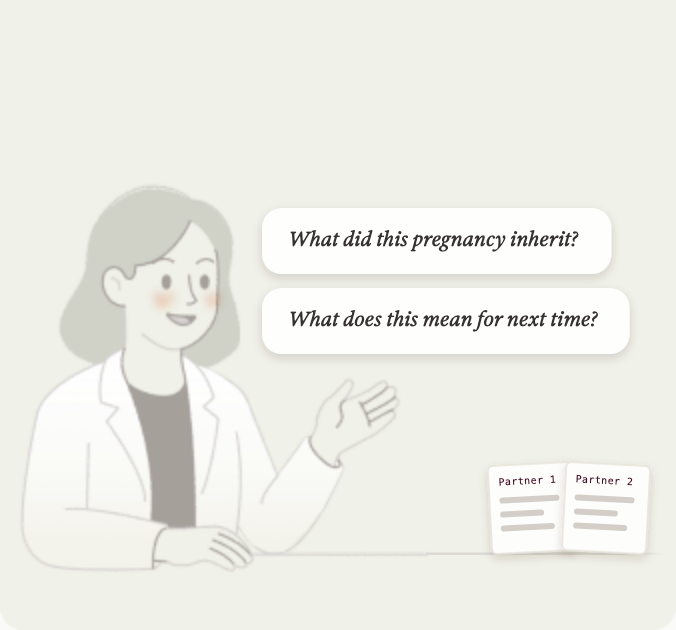
See findings in plain language, then talk them through with a genetic counselor.
Why re-analyze
Original POC checked for
It could not see
A good fit if…
Abnormal result, no pregnancy tissue tested, or embryo PGT-A data? The Infertility & Pregnancy Loss Panel or Embryo reports may fit better.
Sample report
Explore illustrative findings, inheritance context, and a counselor’s interpretation—one couple, start to finish.
Explore at your own pace
The finding
CPLANE1
A gene needed to build cilia—the tiny antennae cells use to steer how an embryo is laid out in its first weeks.
Both variants, one from each
Compound heterozygous · Confidence: High
Genetic counselor review

Reviewed by Christina, Genetic Counselor
Each of you carries one harmful change in the CPLANE1 gene; this pregnancy inherited both copies, one from each of you. That is a 25% chance in each future pregnancy—and a specific thing to test for.
How CPLANE1 is inherited
What the re-analysis screens
750+
genes
Grouped by what each gene does in reproduction.
Screened in you both — and in the pregnancy
The group the published euploid-loss studies read from the pregnancy’s data—Aminbeidokhti 2025 · deCODE, Nature 2025 · Bozhinovski 2025.
Screened in you both
Both genomes are read across every group.
Illustrative example. Your findings and recommendations will depend on your results and clinical history.
Evidence and boundaries
Reticular's reviewed patient resources explain what each test can—and cannot—answer after a loss.
Common questions
It screens both partners across 750+ genes associated with fertility, early embryo development, and recurrent pregnancy loss. The raw data file from your POC lab is analyzed alongside both genomes to see what this pregnancy inherited.
Sometimes. If you both carry a variant in the same gene and the POC data shows this pregnancy inherited both copies, that is a likely explanation. More often, no single cause is found, and the report instead shows inherited risks that matter for a future pregnancy. A chromosomally normal result is common—roughly half of early losses under 35, about 25% after 40. (ACOG; ASRM 2026)
The tissue test counts chromosomes and looks for large missing or extra pieces—it cannot see individual genes. The re-analysis reads the raw data behind that result with both partners’ genomes to look for inherited single-gene causes.
Carrier screening answers a different question: whether you and your partner carry a variant that could affect a future child’s health. It reports your carrier status—it doesn’t read what a pregnancy inherited. Those panels are also built around conditions that appear after birth, so genes tied to pregnancy loss are largely absent; CPLANE1, the gene in our sample report, is not on the gene list ACMG recommends. So a normal carrier screening result doesn’t rule out what this analysis looks for—it answered a different question about different genes.
Both partners return at-home saliva kits, and you request the raw data file from the products of conception (POC) testing lab. Onboarding walks you through that request, so you’re not doing it on your own. We don’t test pregnancy tissue.
It means the re-analysis found no variant that met our reporting standards. That is not the same as ruling out a genetic cause—some are still beyond what today’s testing and evidence can identify.
Karyotype-only results and older aCGH arrays can’t be re-analyzed. If your POC lab can’t release a usable file, we refund the difference to the Infertility & Pregnancy Loss Panel ($749 for both partners) and your report still covers both partners in full.
Yes. A genetic counselor helps place the report in context, explain what a finding does and doesn’t mean, and prepare questions for your care team.
A human next step
Text us a quick question, or book a free conversation with Christina, our genetic counselor, about whether the re-analysis fits.
Our embryo reports use the PGT-A data you already have—no new biopsy.
Are you a POC laboratory? Partner with Reticular →