Reticular

After PGT-A

Help lower your future child’s disease risk.

Use the PGT-A data you already have to compare inherited health risks across every embryo—without another biopsy.

Your embryo report

Compare every embryo

LowerAverageHigherMuch higher
Condition
Embryo 4
Embryo 2
Embryo 7
Embryo 6
Embryo 5
Pregnancy loss
Type 1 diabetes
Glaucoma
Prostate cancer

Embryo 4 · Pregnancy loss: No known risks

  • No new biopsy

  • Counselor review

  • Pay over time

Not sure which option fits?Take the 2-minute quiz

Choose where to begin.

Choose partner screening or an Embryo Report.

Uses existing PGT-A data. No new biopsy; compatibility is confirmed before payment.

Choose your Embryo Report

Choose Core or Complete
See what's included
Continue to checkout

No reportable finding? Full refund. Available only when the completed report has no qualifying result under the published product terms.

Eligibility terms

What the Embryo Report adds

  1. 01

    No new biopsy

    Uses compatible raw data from existing PGT-A

  2. 02

    Compare every embryo

    See chromosome, pregnancy-loss, and health findings

  3. 03

    Counselor review

    Review results with a counselor and care team

What happens next

How the Embryo Report works

From checkout to a report you can discuss with your care team, here’s the process.

  1. Step 01

    We screen your embryos

    After a secure transfer from your lab, we analyze the compatible PGT-A data you already have.

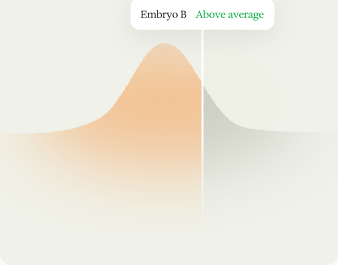
    Embryo scoring curve with one embryo marked above average.
  2. Step 02

    We explain the report

    A genetic counselor walks you through the findings and helps you prepare questions for your care team.

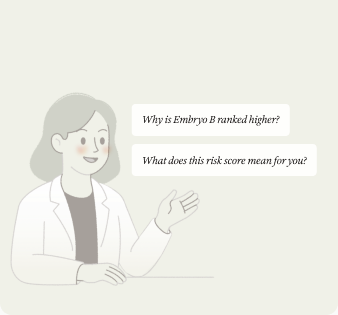
    Genetic counselor explaining embryo results.
  3. Step 03

    You decide with clarity

    Use the report with your care team to make the choice that best fits your family’s priorities.

    Embryo illustration with a warm glow.

Embryo Report · Complete

See every finding included today

Complete adds 23 modeled health conditions and measurements to the pregnancy-loss findings included in Core.

These are modeled genetic estimates, not diagnoses or predictions of health, pregnancy, or transfer outcomes.

24 findings1 pregnancy-loss screening + 23 modeled health findings

Fertility & pregnancy loss

Included in Core

Pregnancy loss screening

Core reviews chromosome and reportable fertility or pregnancy-loss gene findings. The finding shown depends on your family and embryo data.

Modeled health conditions & measurements

23 findings

Each row estimates genetic predisposition relative to the model's reference population. Non-genetic factors also shape health.

Heart & blood

  • High blood pressure
  • Dyslipidemia
  • High cholesterol
  • Coronary artery disease
  • Atrial fibrillation
  • Red blood cell count

Immune & respiratory

  • Allergies or eczema
  • Asthma
  • Inflammatory bowel disease
  • Celiac disease
  • Type 1 diabetes

Cancer

  • Basal cell skin cancer
  • Breast cancer
  • Prostate cancer
  • Melanoma

Bone & joint

  • Osteoporosis
  • Bone mineral density
  • Gout

Brain & mind

  • Alzheimer's disease
  • Migraine
  • Schizophrenia

Eye & vision

  • Glaucoma
  • Myopia
See these findings in the sample report

Sample report

Compare every embryo side by side

See chromosome, gene-level, and health findings in one report.

2:10

Guided sample report

A genetic counselor walks through a sample report

Christina explains how to read the main finding, partner results, counselor context, and possible next steps.

Educational example only. Your results and next steps will depend on your history and care team.

Read the walkthrough summary
  1. Start with the report summary: it highlights the findings most relevant to the couple’s history without treating them as a diagnosis.
  2. Compare each partner’s results, then open an individual finding to see the evidence, inheritance pattern, and plain-language interpretation.
  3. Use Christina’s counselor note to separate the result that may help explain the losses from lower-risk carrier information.
  4. Bring the result and suggested next steps to a reproductive genetics specialist or genetic counselor for decisions specific to your history.

Explore at your own pace

Explore the sample yourself

Embryo report · comparison

Embryo 4 stands out

Compare chromosome status, pregnancy-loss findings, and health estimates in one view.

Highlighted findings compared across three embryos
FindingEmbryo 4EuploidEmbryo 2EuploidEmbryo 7Euploid
Pregnancy loss
No known risks
Moderate risk
Higher risk
Type 1 diabetes
-24%
-80%
+32%
Glaucoma
-32%
-48%
+10%
LowerAverageHigherMuch higher

Takeaway

Embryo 4 is the only embryo here with no known pregnancy-loss risk; Embryo 2 trends lower on both modeled conditions.

Embryo report · detail

Embryo 7 needs a closer look

EuploidHigher risk

Key finding

TUBB8

A gene-level finding linked to egg maturation and early embryo development.

Context

The chromosome result is euploid. Review the separate TUBB8 finding with a reproductive genetics specialist.

Embryo report · counselor

Christina, Genetic Counselor

Counselor takeaway

Christina · Genetic Counselor

Embryo 7 is euploid and has a separate TUBB8 finding. Weigh them as two distinct pieces of evidence.

Ask next

How should this fit with embryo grade, clinical history, and your goals?

Decision support for you and your care team—not a transfer decision.

1 of 3

View the complete sample report (opens in a new tab)

Illustrative example. Your findings and recommendations will depend on your results and clinical history.

Infertility & Pregnancy Loss Panel

Straight answers before you order.

Understand what the panel tests, who it can help, what you receive, and what happens after your saliva kit reaches the lab.

For the Infertility & Pregnancy Loss Panel, Reticular mails you an at-home saliva kit and screens 750+ reproductive genes. You receive a personal report that explains any meaningful findings, their evidence and inheritance context, plus a conversation with a genetic counselor who helps you understand what to discuss with your care team.

The panel is designed for people planning a pregnancy, navigating unexplained infertility, or looking for more information after recurrent pregnancy loss. You do not need to be doing IVF, and you do not need existing embryo data to order it.

Testing both partners provides the most complete shared view because the report can consider each person's findings together. Testing one partner can still be a useful starting point. The panel costs $250 for one partner or $500 for both, and a genetic counselor can help you choose the option that fits your situation.

These tests look at different parts of the picture. Carrier screening usually asks whether partners could pass certain inherited conditions to a child, while a standard infertility evaluation may examine anatomy, hormones, semen, chromosomes, and other common factors. Reticular looks at individual genes connected to fertility, early embryo development, and pregnancy loss, adding a genetic layer those evaluations may not cover.

You can use the saliva panel before or during IVF to learn about reproductive-gene findings in one or both partners. If you already have compatible embryo sequencing data, Reticular also offers embryo reports that add pregnancy-loss, health-condition, and trait context without requiring a new embryo biopsy.

Yes. The relevant testing depends on whose egg and sperm will create the pregnancy and what screening has already been completed. Reticular can screen the intended genetic parent or parents, and a genetic counselor can help map the appropriate option to a donor or surrogacy plan.

If Reticular finds something meaningful, the report explains the gene, supporting evidence, and inheritance pattern. Your genetic counselor helps translate it into focused questions for your fertility clinician. Depending on the finding, your care team may discuss targeted testing, partner or family testing, IVF options, or other reproductive planning. The report supports those decisions; it is not itself a medical diagnosis or treatment plan.

A negative result means no reportable finding was identified within the genes and methods used by the panel. Your counselor can explain what was checked, what the result makes less likely, and which other parts of a fertility or recurrent-loss evaluation may still be useful.

We mail the kit to you, you collect the saliva sample at home, and you return it using the included materials. Results are typically ready about three weeks after the sample reaches the laboratory. Genetic counseling is included in the panel price.

Reticular encrypts genetic and personal information in transit and at rest, limits access to the people and systems working on your service, and does not sell your health information. You can request a copy or deletion of your data at any time.