Reticular

Exploring genetic testing

Choose the right test for your next step.

Screen fertility genes now. Add embryo analysis later if you pursue IVF.

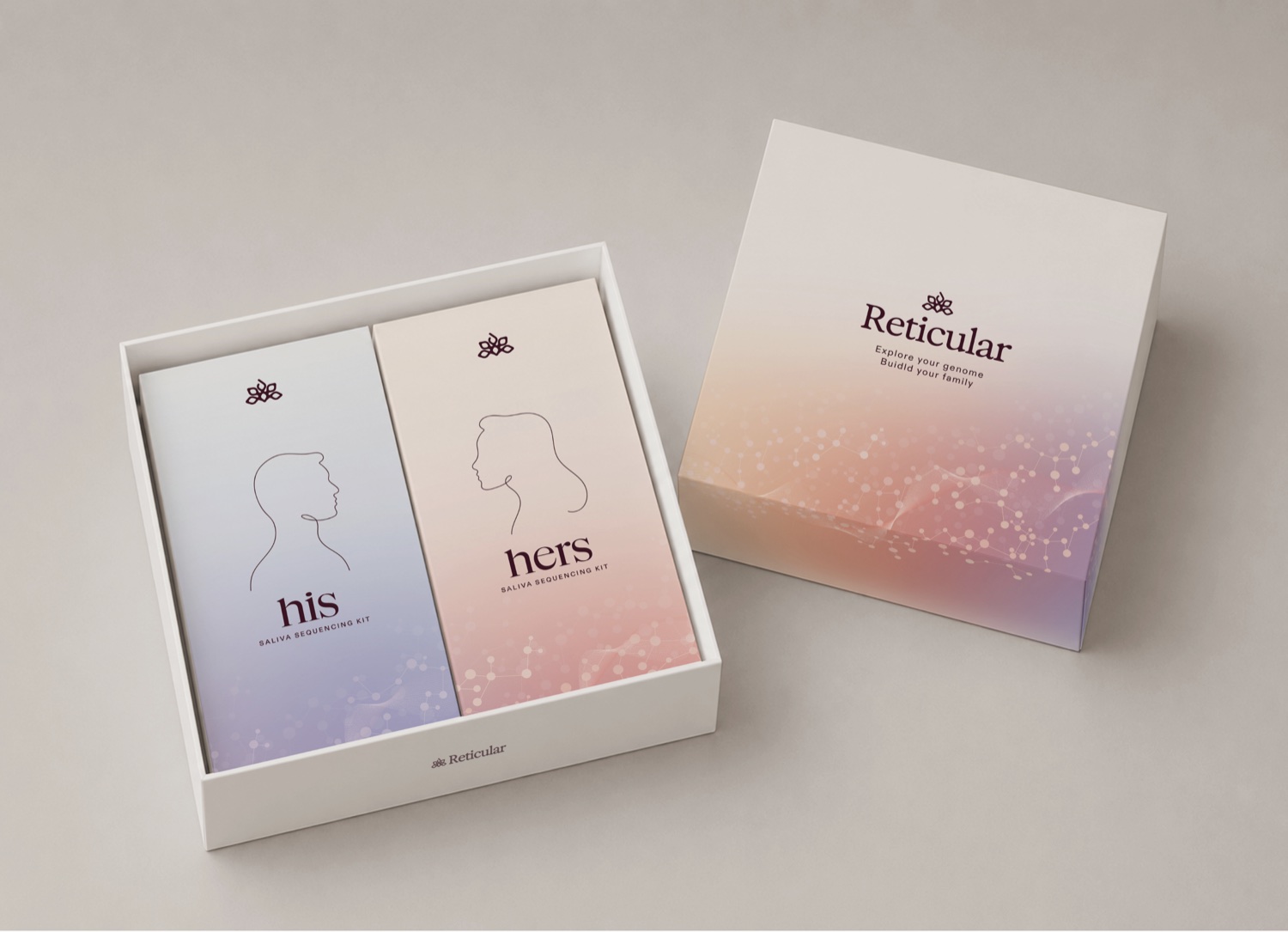
Reticular at-home saliva sequencing kit for two partners
  • Free shipping

  • HSA/FSA eligible

  • Pay over time

Not sure which option fits?Take the 2-minute quiz

Choose where to begin.

Choose partner screening or an Embryo Report.

At-home cheek swab screening. No IVF or embryos needed.

Infertility & Pregnancy Loss Panel

Screen 750+ reproductive genes at home, with counseling included.

Choose checkout

One partner

$250

Both partners

$500

No reportable finding? Full refund. Available only when the completed report has no qualifying result under the published product terms.
Eligibility terms

What the panel includes

  1. 01

    750+ reproductive genes

    Focused on infertility and recurrent loss

  2. 02

    Results in about 3 weeks

    After your saliva samples reach the lab

  3. 03

    Counseling included

    Review findings with a genetic counselor

What happens next

How the panel works

From checkout to results, here’s what happens after you choose a plan.

  1. Step 01

    Test at home

    Choose one or both partners. We ship each person a saliva kit with everything needed to return it.

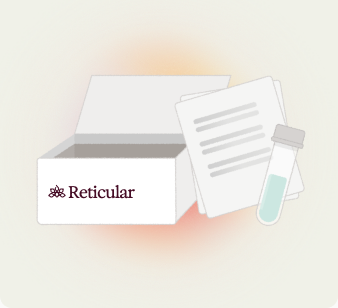
    Reticular test kit, papers, and sample vial.
  2. Step 02

    We screen the results

    After you send the kits back, the lab sequences and reviews reproductive genes.

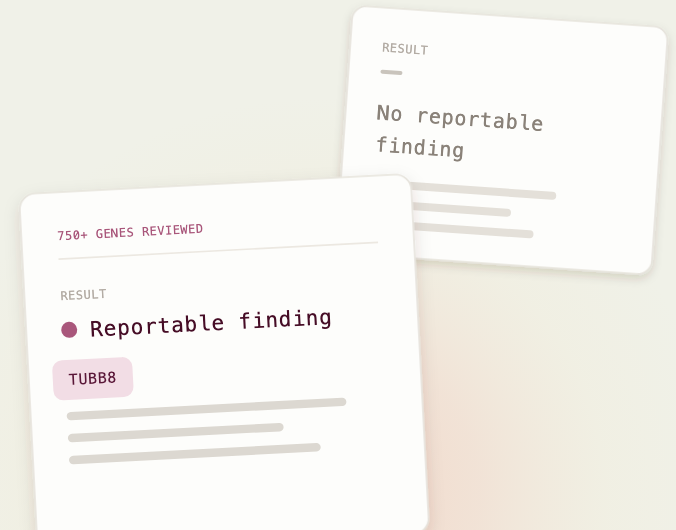
    Illustrative panel results: one card with a reportable finding, one with no reportable finding.
  3. Step 03

    We explain your report

    See findings in plain language, then talk them through with a genetic counselor and your care team.

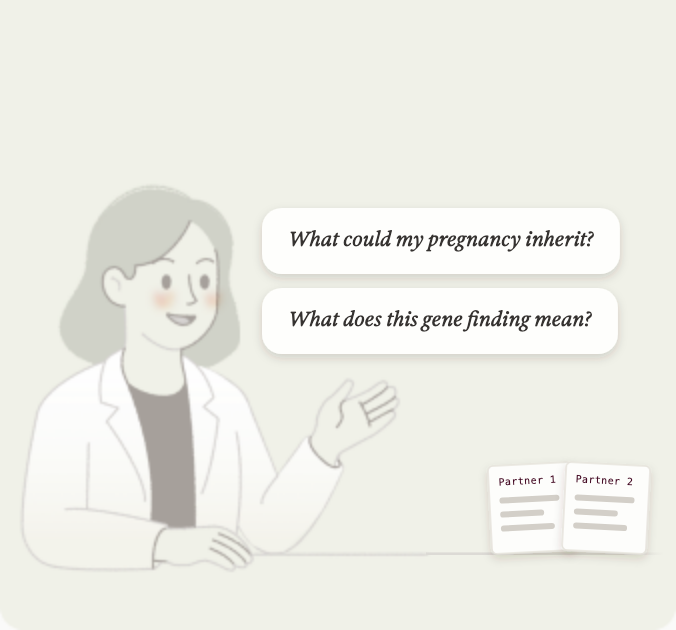
    Genetic counselor explaining a panel report to both partners.

Sample report

See what a reproductive-gene report looks like

Preview partner findings, plain-language context, and a genetic counselor’s interpretation.

2:10

Guided sample report

A genetic counselor walks through a sample report

Christina explains how to read the main finding, partner results, counselor context, and possible next steps.

Educational example only. Your results and next steps will depend on your history and care team.

Read the walkthrough summary
  1. Start with the report summary: it highlights the findings most relevant to the couple’s history without treating them as a diagnosis.
  2. Compare each partner’s results, then open an individual finding to see the evidence, inheritance pattern, and plain-language interpretation.
  3. Use Christina’s counselor note to separate the result that may help explain the losses from lower-risk carrier information.
  4. Bring the result and suggested next steps to a reproductive genetics specialist or genetic counselor for decisions specific to your history.

Explore at your own pace

Explore the sample yourself

Partner results

Maya

Review finding

Egg source

TUBB8

Related to egg maturation and early embryo development.

Also found: DHCR7 carrier result — a separate carrier-screening finding.

Daniel

Review finding

Sperm source

PLCZ1

May affect the sperm’s ability to activate the egg after fertilization.

Genetic counselor review

Christina, Genetic Counselor

Christina's counselor note

Reviewed by Christina, Genetic Counselor

Your report found a change in PLCZ1, a gene involved in sperm activation after fertilization. This result does not diagnose infertility, but it gives your care team a specific finding to review alongside your history and other testing.

A finding is information to discuss—not a prediction of whether you will conceive.

Your care team can use this information to discuss next steps with you.

What you can do next

Parent resting beside a sleeping baby

Step 1 · Review your result

Review the finding with a specialist

Meet with a reproductive genetics specialist or genetic counselor to review the evidence and discuss whether the finding fits your history.

Adult hands gently holding a newborn's foot

Step 2 · Add clinical context

Compare it with your clinical history

Bring prior fertility testing, treatment history, and family records so your care team can interpret the finding in context.

Parent holding a baby at home

Step 3 · Explore your options

Decide whether more testing adds context

Ask whether testing a partner, reviewing carrier screening, or using future embryo data would add useful information.

1 of 3

Speak with a specialist (opens in a new tab)

A positive panel is a starting point, not a verdict.

1 of 3

View the complete sample report (opens in a new tab)

Illustrative example. Your findings and recommendations will depend on your results and clinical history.

Infertility & Pregnancy Loss Panel

Straight answers before you order.

Understand what the panel tests, who it can help, what you receive, and what happens after your saliva kit reaches the lab.

For the Infertility & Pregnancy Loss Panel, Reticular mails you an at-home saliva kit and screens 750+ reproductive genes. You receive a personal report that explains any meaningful findings, their evidence and inheritance context, plus a conversation with a genetic counselor who helps you understand what to discuss with your care team.

The panel is designed for people planning a pregnancy, navigating unexplained infertility, or looking for more information after recurrent pregnancy loss. You do not need to be doing IVF, and you do not need existing embryo data to order it.

Testing both partners provides the most complete shared view because the report can consider each person's findings together. Testing one partner can still be a useful starting point. The panel costs $250 for one partner or $500 for both, and a genetic counselor can help you choose the option that fits your situation.

These tests look at different parts of the picture. Carrier screening usually asks whether partners could pass certain inherited conditions to a child, while a standard infertility evaluation may examine anatomy, hormones, semen, chromosomes, and other common factors. Reticular looks at individual genes connected to fertility, early embryo development, and pregnancy loss, adding a genetic layer those evaluations may not cover.

You can use the saliva panel before or during IVF to learn about reproductive-gene findings in one or both partners. If you already have compatible embryo sequencing data, Reticular also offers embryo reports that add pregnancy-loss, health-condition, and trait context without requiring a new embryo biopsy.

Yes. The relevant testing depends on whose egg and sperm will create the pregnancy and what screening has already been completed. Reticular can screen the intended genetic parent or parents, and a genetic counselor can help map the appropriate option to a donor or surrogacy plan.

If Reticular finds something meaningful, the report explains the gene, supporting evidence, and inheritance pattern. Your genetic counselor helps translate it into focused questions for your fertility clinician. Depending on the finding, your care team may discuss targeted testing, partner or family testing, IVF options, or other reproductive planning. The report supports those decisions; it is not itself a medical diagnosis or treatment plan.

A negative result means no reportable finding was identified within the genes and methods used by the panel. Your counselor can explain what was checked, what the result makes less likely, and which other parts of a fertility or recurrent-loss evaluation may still be useful.

We mail the kit to you, you collect the saliva sample at home, and you return it using the included materials. Results are typically ready about three weeks after the sample reaches the laboratory. Genetic counseling is included in the panel price.

Reticular encrypts genetic and personal information in transit and at rest, limits access to the people and systems working on your service, and does not sell your health information. You can request a copy or deletion of your data at any time.

Find your Reticular plan | Reticular